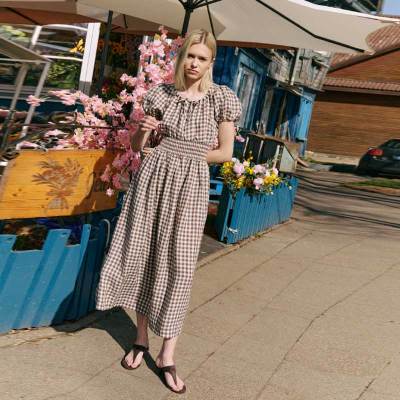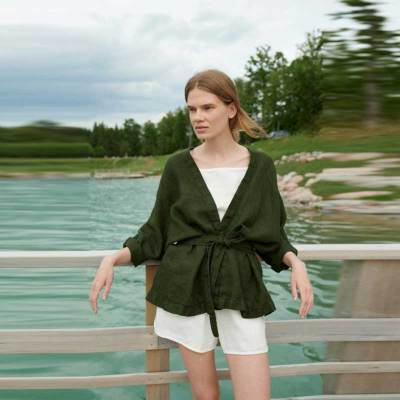
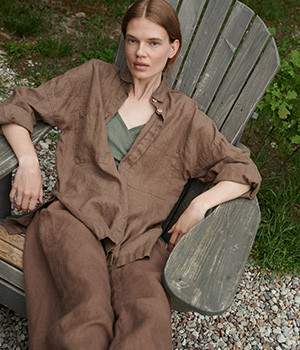
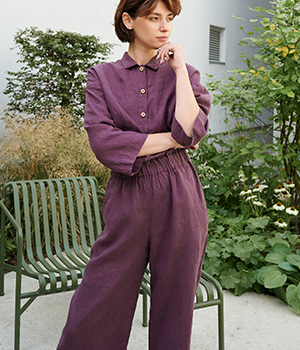
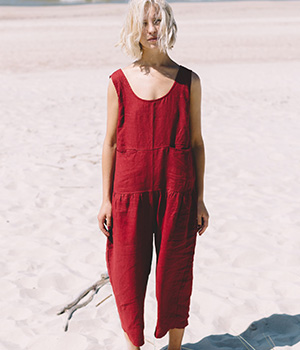
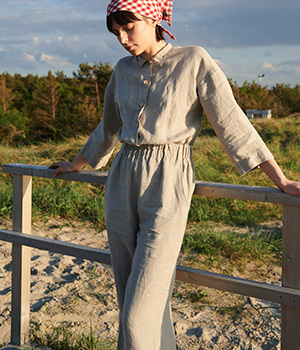
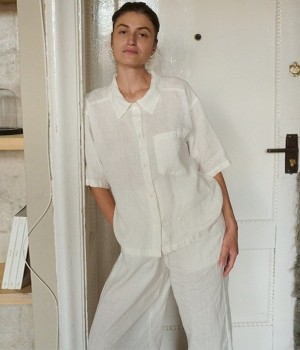
Linen Uniforms for Spa, Salon and Wellness Brands
Linen uniforms for spa, salon and wellness brands are a different manufacturing problem from hospitality uniforms, even though both are worn by staff on shift. A therapist works in a warm, humid treatment room and needs a garment that absorbs moisture, stays soft against skin and survives being laundered several times a week. A salon stylist works standing, reaching and leaning over a basin and needs a garment that does not cling, does not show every crease as a defect and can carry a discreet logo. A wellness brand sells calm, and the uniform is the most visible piece of that promise. This guide explains how to specify, sample and produce a linen uniform programme for spa, salon and wellness businesses, from fabric weight and absorbency through washing durability, style sets, embroidery and sizing, to MOQ, cost and lead time. The short answer is that linen works well for wellness uniforms when it is specified correctly. The mistake most brands make is to order the same fabric they use for retail dresses. A treatment-room tunic needs a softer, pre-washed or enzyme-washed linen in a mid-weight range, a colourfastness standard that survives an industrial wash cycle, and a cut that allows full shoulder movement without pulling. Get those three right and linen outperforms polyester-cotton on comfort and on brand feel. Get them wrong and you get a garment that stiffens after three washes, fades unevenly, or restricts the therapist's arms. Linenwind is a linen garment manufacturer in Dongguan, China, with more than 20 years of OEM and ODM experience for brands in Europe and North America. We produce uniforms as a dedicated category, separate from our retail ranges. Our published figures for uniform and apparel programmes are 60 pieces per style per colour as the minimum order quantity, counter samples in 7-12 days with a realistic sampling window of 7-14 days, bulk production in 25-35 days, a first order of roughly 35-60 days end to end, first-wash shrinkage held to 3-7 percent, fabric weights from about 100 to 260 GSM, more than 50 fabric specifications held in stock, AQL 2.5 inspection, and certification coverage including ISO 9001, OEKO-TEX Standard 100 and SEDEX membership. If your remit is wider than wellness, our guide to linen uniform manufacturing for hospitality brands covers aprons, chef jackets and server shirts, and the question of whether linen is suitable for work clothes sets out the general case. A wellness uniform has to perform in conditions that are closer to a domestic laundry cycle than to an office. Treatment rooms run warm and humid, therapists move continuously through massage, facials and body treatments, and the garment is in contact with oils, creams and water rather than with a keyboard. Linen's fibre structure is hollow at the core, which is why it moves moisture away from the skin and dries faster than cotton of the same weight. In a treatment-room tunic that matters more than abrasion resistance, because the failure mode a therapist notices is a damp, clinging garment halfway through a shift, not a worn-out hem. There are four material properties that consistently justify linen in a spa or salon uniform programme: The counter-argument is creasing and shape retention, and it is a real one. Linen creases, and a structured uniform that needs a sharp shoulder line is a poor fit for pure linen. The practical answer is either to accept a relaxed silhouette, which suits spa and wellness positioning well, or to specify a linen-cotton or linen-Tencel blend in the areas where a cleaner line matters. Our comparison of uniform construction for service environments explains where a blend earns its place, and the fabric direction for each style is set out in the next section. Most spa, salon and wellness operators do not need one uniform. They need two or three, because the people wearing them do genuinely different jobs. Grouping the programme this way is the fastest way to control cost, because each group can be specified at the fabric weight and construction level it actually needs. Therapists, massage therapists, facialists and body-treatment specialists. Wear time is long, movement is repetitive and physical, and the garment is in constant skin contact. Priority is absorbency, softness and unrestricted shoulder movement. A relaxed tunic or wrap top over straight trousers works; sleeves are usually short or three-quarter because forearms are in contact with product and with the client. Receptionists, hosts and retail advisors. The garment is client-facing from the moment a guest arrives, so appearance and colour consistency matter more than absorbency. A tailored tunic, a shirt-style top or a light waistcoat reads better than a loose therapist tunic. Fabric can sit slightly lighter and stiffer because the wearer is not working in a humid room. Room turnover, laundry handling, pool and wet-area attendants. This group needs the most wash cycles and the highest soil exposure. Prioritise colourfastness, abrasion resistance and a simple block that can be re-ordered cheaply. A straight tunic with patch pockets and a wrap apron is the usual answer. Operators who try to run a single uniform across all three groups usually end up compromising: the fabric is too heavy for reception, or too light for back-of-house, or too structured for a therapist. Specifying three groups at the sampling stage costs nothing extra, because the counter sample is charged per style, and it prevents a mid-programme redesign. For operators starting small, our guide to small-batch linen production explains how to phase a rollout one group at a time.Why Linen Suits the Spa and Wellness Environment
The Three Uniform Groups Inside One Wellness Business
Treatment and Therapy Team
Front of House and Reception
Back of House and Spa Attendants
Fabric Specification for Wellness Uniforms
Fabric weight is the first decision and the one that most often goes wrong. Linens used for wellness uniforms sit between about 140 and 200 GSM. Below that, a tunic becomes semi-transparent if the colour is light and does not hold its shape over a shift. Above about 220 GSM the fabric is durable but begins to feel heavy on the shoulders and takes longer to dry, which is the opposite of what a therapist wants. A 160 to 180 GSM washed plain weave is the most common specification for treatment-room tunics; trousers generally sit slightly heavier at 180 to 200 GSM so the knee does not bag out.
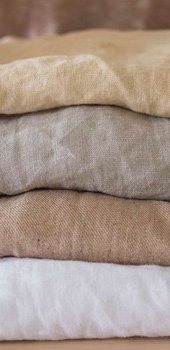
Weave and finish matter as much as weight. A plain weave is the standard choice for tunics, trousers and shirts. An enzyme-washed or stone-washed finish softens the surface and removes the crispness that new linen has, which is a real advantage for a garment worn against skin for eight hours. Garment-dyed linen is popular for wellness programmes because each style can be dyed to the brand palette and the muted, slightly irregular colour reads as natural rather than as a uniform. For more on how these finishes behave, see our breakdown of washed, enzyme and stone-washed linen finishes.
| Uniform element | Typical GSM | Weave / finish | Why |
|---|---|---|---|
| Therapist tunic | 150-180 | Plain weave, enzyme or washed | Soft hand feel, full shoulder movement, quick drying |
| Draped wrap top | 140-170 | Plain weave or gauze, washed | Softness and drape for a wrap silhouette |
| Reception tunic or shirt | 160-190 | Plain weave, lightly washed | Slightly crisper line for client-facing wear |
| Uniform trousers | 180-220 | Plain or twill, washed | Shape retention at knee and seat |
| Apron and wrap | 200-260 | Twill or heavy plain, washed | Abrasion resistance for back-of-house and wet areas |
| Robe and lounge layer | 140-170 | Gauze or washed plain | Lightness and drape over another garment |
| Linen-cotton or linen-Tencel blend | 150-200 | Blend, washed | Fewer creases where a cleaner line is required |
Colour specification is where wellness programmes differ from fashion programmes. Colours are usually muted and low-chroma: undyed natural, oatmeal, sand, sage, clay, warm grey, charcoal and off-white. Two constraints matter. First, undyed and very light colours show stains and body oils, so they work best in reception and retail roles rather than in treatment or wet areas. Second, colour consistency across repeat orders depends on the dye lot, so ask your manufacturer to hold a lab-dip or approved colour standard for each shade in the programme and to state the accepted tolerance, usually assessed against a grey scale for colour change. Our notes on yarn-dyed, piece-dyed and garment-dyed linen explain which route gives the most consistent result when a programme runs for several seasons.
A uniform programme that will be re-ordered should always have an approved colour standard and a sealed reference sample held by the factory. Without one, the third or fourth re-order is where colour drift becomes visible in a mixed team.
Absorbency interacts with construction as well as fibre. A treatment-room tunic with a plastic-backed panel, a coated collar, or a heavy resin finish will not breathe, however good the base fabric is. Keep interlining to a minimum, avoid resin-treated finishes on therapist garments, and choose woven rather than fusible interfacing where a collar or placket needs support. Where a garment is expected to be worn over a fitted base layer, a 150 to 170 GSM linen layer adds warmth without trapping moisture.
Blends are worth considering for specific roles rather than across the whole programme. A linen-cotton blend at roughly 55/45 gives a more stable surface and fewer visible creases, which suits reception and management uniforms. A linen-Tencel blend adds drape and a slightly smoother hand feel, which some wellness operators prefer for wrap tops. Pure linen remains the right choice for therapist wear and back-of-house, where breathability and durability are the priorities. The trade-offs are set out in our guide to linen-Tencel blend fabric.
Wash Durability: The Real Test for a Spa Uniform
A spa uniform is not washed once a week. In many operations it is washed after every shift, and in larger properties it goes through an on-premise laundry or a contract laundry rather than a domestic machine. That changes the specification. The fibre has to survive repeated wet cycles, the dye has to hold, and the construction has to keep its shape without being pressed back into line after every wash.
Three tests tell you whether a linen uniform will survive the programme it is bought for:
- Dimensional stability after repeated washing. Linen shrinks on first wash, and the accepted figure for a properly pre-shrunk fabric is 3-7 percent. Ask for the shrinkage result for both warp and weft after a defined number of washes, not just after the first one.
- Colourfastness to washing and to light. Colour change and staining are usually judged against a grey scale, and a uniform programme should specify a minimum grade rather than accepting whatever the first bulk delivery produces.
- Appearance after laundering, including pilling, seam distortion, and whether the garment needs ironing to look acceptable. A uniform that only looks right when pressed is a uniform that will look wrong most of the time.
| Laundry condition | What it stresses | Specification response |
|---|---|---|
| Frequent domestic-style wash, 40°C | Fibre wear, colour loss | Washed or enzyme finish, colourfast dye, reinforced seams |
| Higher-temperature wash, 60°C | Shrinkage, colour bleeding | Pre-shrunk fabric, colour standard tested at 60°C |
| Oxygen-based bleach permitted | Dye stability, fibre strength | Select dye class accordingly, test on bulk dyed fabric |
| Tumble drying | Shrinkage, seam puckering | Higher shrinkage allowance in the pattern, or line-dry instruction |
| Industrial or contract laundry | All of the above at higher intensity | Heavier GSM, stronger thread, bar-tacked stress points |
The practical lever is construction, not just fibre. Bar-tack pocket corners and pocket mouths, use a durable thread, and finish stress points where a therapist pulls or reaches. Waistbands should use encased elastic rather than exposed elastic, because exposed elastic fails long before the linen does. Trousers benefit from a two-piece back waistband or a small elastic insert, which reduces the strain on the seam when the wearer crouches. These are low-cost details that decide whether a uniform still looks presentable after one season.
It is also worth agreeing in writing how shrinkage has been handled in the pattern. If the fabric is pre-shrunk to 3-7 percent and the pattern is cut to the post-wash dimension, the garment arrives correct and stays correct. If the pattern is cut to the greige dimension, the first wash will change the fit and the team will report that the uniforms ran small. Our explanation of linen shrinkage control covers the pre-shrinking routes in detail, and the applicable standards are the same ones used for retail programmes.
Ask for a wash-tested reference garment, not only a counter sample. A counter sample tells you how the garment fits and feels on day one. A wash-tested sample tells you what the team will actually wear in month three.
Where a wellness brand also sells retail product, a useful side effect of specifying uniform linen properly is that the same fabric and finish can be carried into a retail robe or loungewear piece. That creates a coherent brand story and usually reduces cost, because the fabric is already qualified. Our guide to linen loungewear and sleepwear covers the retail side of that decision.
Style Sets: Building a Coherent Uniform Range
A wellness uniform range works best as a small, fixed set of blocks that share fabric, colour and trim. Six to eight styles usually cover an entire site, and every style after that adds sampling cost, stock and laundry complexity without adding much. The blocks that recur across spa, salon and wellness programmes are:
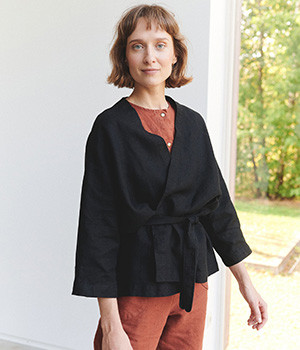
- Therapist tunic. A relaxed A-line or straight tunic, short or three-quarter sleeve, with two low patch pockets and a short side vent. The hem length should be set so the wearer can reach overhead without the tunic pulling clear of the waistband.
- Wrap top. A true wrap or a mock-wrap with a fixed inner panel. The mock wrap is more practical for uniform use because it cannot come open mid-treatment.
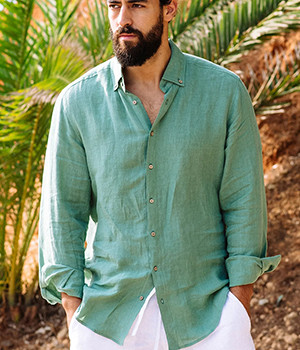
- Reception shirt or blouse. A linen shirt block with a soft collar, set-in sleeve and a clean front placket. This is the piece that carries the brand most visibly.
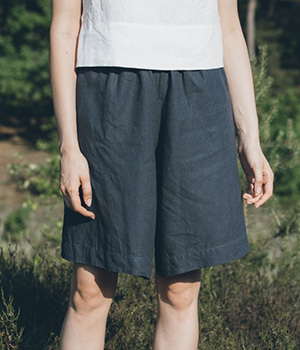
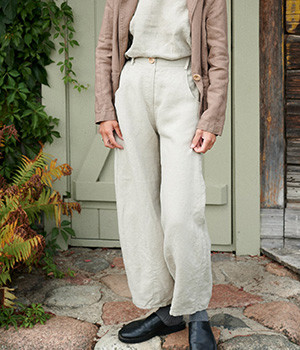
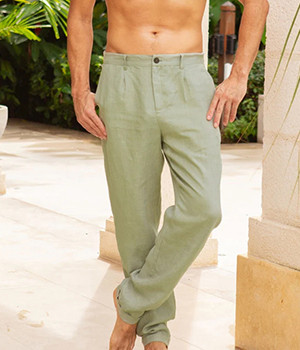
- Straight-leg uniform trouser. Mid-rise, flat front, elastic insert at the back waist, two side pockets or one cargo pocket depending on role.
- Wrap apron. A cross-back or waist apron in heavier linen for back-of-house and wet areas.
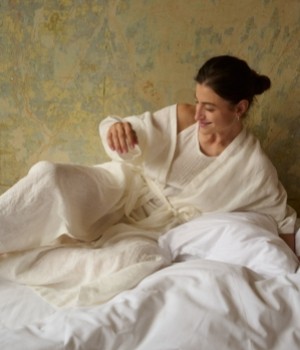
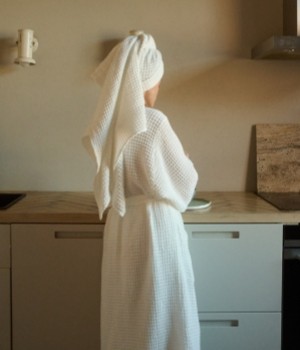
- Robe. Lightweight, shawl-collar, belt or tie closure. Used for wet areas, thermal suites and as part of a retail collection.
- Layer piece. A light linen overshirt or waistcoat for reception and management.
Two decisions determine whether the range looks like a collection or like a set of unrelated garments. First, keep the palette to three to five shades and assign them by group rather than by individual. Second, use one trim language across the range: the same pocket stitch, the same button, the same label placement. Our guidance on designing professional linen collections for workwear sets out how to plan that at the development stage.
Brand Identity: Embroidery, Labels and Colour
Wellness brands almost always want a visible logo, but a uniform is not a marketing banner. The most durable approach is a small embroidery or a woven badge placed consistently, plus a proper label package inside the garment. Linen embroiders well when the design is chosen for the fabric, and it embroiders badly when a dense, flat logo is placed over a loose weave.
Practical rules that hold up in production:
- Keep embroidery under about eight centimetres wide on a tunic and under about six centimetres on a shirt collar area, unless the design is intentionally oversized.
- Avoid very dense, solid fills on light-coloured linen, because the needle perforations can show through from the inside and the fabric can pucker around the motif.
- Place chest embroidery on a stable area, and use a cut-away backing rather than a tear-away where the garment will be washed frequently.
- Design for one or two thread colours. Multi-colour detail is lost at uniform scale and costs more per piece.
- Repeat the brand on the inside: a woven main label, a care label with fibre content and origin, and a size label that is softer than the main label so it does not irritate the neck.
The technical constraints of decorating linen, including stitch density and how different designs behave after washing, are covered in our complete guide to embroidery on linen and in the notes on printing on linen for brands that prefer a printed mark. If your label programme is still open, the question of whether a linen manufacturer can add your logo and labels answers the packaging side.
Order one embroidered sample before bulk. Embroidery changes the drape and stiffness of the panel it sits on, and that is visible on a tunic far more than on a shirt.
Sizing Across a Shift-Based Workforce
A wellness team is not a fashion size run. Staff range from petite to tall, and a single site may need both men's and women's fits plus a genuinely unisex option for shared roles such as room turnover. A uniform programme that only offers a women's fit in six sizes will fail at the point of issue, not at the point of sale.
A practical size plan for a wellness uniform programme covers:
- Women's fit from XS to 3XL, with the key measurements being bust, waist, hip, back length and sleeve length rather than a nominal size label.
- A men's or unisex fit from S to 3XL for shared roles and for male therapists.
- Two length options on tunic and trouser blocks, which is cheaper than adding sizes and solves most of the tall and petite problems.
- An elastic-insert or adjustable waist on trousers, which absorbs small differences in waist measurement and reduces the number of exchange requests.
- A stated tolerance for measurement, so that a garment within tolerance is not treated as a defect.
Fit is also the point where a uniform programme most often goes wrong in practice. The reliable approach is to sample in two sizes that bracket the middle of the run, fit them on real staff, and adjust the pattern before grading. If your programme spans markets, sizing should be planned by market from the start; our guide to getting a quote for custom linen clothing lists the measurements a factory needs to quote accurately, and the wider question of how a linen garment moves through development is covered in our factory qualification guide.
Sampling, MOQ and Lead Time for a Uniform Programme
Uniform programmes are usually smaller in quantity and more sensitive to fit than retail ranges, so the development stage matters more. Our standard sequence for a spa or salon uniform programme runs from a brief and reference images, through fabric selection from stock or development, pattern making, a counter sample, a fit review, a pre-production sample, bulk production, inspection and shipping.
| Stage | Typical duration | What happens |
|---|---|---|
| Brief and quote | 48 hours initial reply, 3-7 working days for pricing | Styles, roles, fabric, colours, sizes, quantities |
| Fabric selection | Immediate for stock qualities | Choose from more than 50 specifications held in stock, or develop a custom quality |
| Pattern making and counter sample | 7-12 days, allow 7-14 | Pattern, sewing, trim, label and embroidery placement |
| Fit review and revisions | 3-7 days per revision round | Adjustments based on staff fittings |
| Pre-production sample | 5-10 days | Sealed sample in production fabric and colour |
| Bulk production | 25-35 days | Cutting, sewing, finishing, pressing, packing |
| First order end to end | 35-60 days | From brief to shipment for a first-time programme |
The minimum order quantity for a uniform programme is 60 pieces per style per colour. That is low by industrial standards and it is deliberate: it lets a single-site spa or a small salon group run a properly made uniform without ordering stock it will never issue. Where a programme needs several roles, the MOQ is best spread across a small number of blocks rather than across many. Sampling is charged at roughly 40 to 150 US dollars depending on the complexity of the style, and the sample fee is refundable against the bulk order. Fabric swatches are free.
On cost, a uniform garment is built from the same components as any other garment: fabric, labour, trims, finishing, packing and freight. In a typical linen programme fabric accounts for roughly 30 to 45 percent of the unit cost, depending on weight and whether the quality is a stock line or a custom dye lot, and labour accounts for roughly 25 to 35 percent, driven by the number of sewing operations. Embroidery, custom labels, garment dyeing and heavier constructions all move the number. Our breakdown of the seven cost drivers in custom linen clothing explains where the money goes, and the negotiation levers from pricing structure to payment terms are covered in negotiating with a linen manufacturer. For the timeline in more detail, see linen clothing lead times.
Plan a uniform rollout around a season, not around a date. A first programme that starts four months before the opening date has room for a fit revision and a second sample. A programme that starts six weeks out has none.
Quality Control and Compliance
Uniforms are inspected to the same standard as retail garments. The accepted inspection method is AQL 2.5, a sampling-based standard under which a defined number of pieces from each lot are examined for critical, major and minor defects. A critical defect is one that makes the garment unsafe or unusable, a major defect is a visible defect that would stop a customer accepting the piece, and a minor defect is a cosmetic issue that does not affect wear. The inspection usually happens at the end of production before packing, and an interim inspection during sewing catches problems earlier and more cheaply.
For wellness uniforms the defect list should be agreed before production, because the tolerances are different from fashion. The points to define are colour consistency across the order and against the approved standard, measurement within tolerance, shrinkage after the specified wash, seam strength and neatness, embroidery placement and registration, label content and placement, and appearance after laundering. Our guide to linen garment quality inspection explains how the sampling plans work, and the question of what inspections happen during production covers the stages at which checks are made.
On compliance, wellness brands increasingly need to evidence material safety to their own clients. The relevant coverage for our production is ISO 9001 for quality management, OEKO-TEX Standard 100 for harmful substance limits on the finished textile, and SEDEX membership for ethical trade and labour practice. The specific certification you need depends on your market and your clients; our comparison of linen manufacturer certifications explains what each one covers and how to verify it, rather than relying on a supplier's summary. Organic linen programmes follow the same logic but require chain-of-custody documentation through the supply chain.
Two further checks are specific to a wellness environment. First, ask for the absorbency or wicking expectation to be stated in the specification rather than assumed from the fibre content, because a heavy finish can reduce it. Second, agree the expected garment life in washes, so that fading or seam failure within that window is treated as a supplier issue rather than normal wear. The durability characteristics that drive that number are set out in our notes on how long linen lasts.
Rolling Out the Programme in Stages
Most wellness operators do not replace every uniform at once. A staged rollout keeps the spend predictable and gives you a real garment to evaluate before committing to the full site.
- Scope the roles. Count heads by group, and record who needs which block and how often the garment is washed.
- Set the fabric and colour standard. One fabric per group, three to five colours across the range, with a sealed standard held by the factory.
- Sample two sizes and fit them on real staff. Adjust the pattern before grading, not after bulk.
- Run a pilot group. Equip one team for a full wash cycle, then review comfort, shrinkage, colour and creasing with the people wearing it.
- Confirm the label and embroidery package. Finalise placement, thread colour and care label content before bulk.
- Place the bulk order by group. Rolling out reception first and treatment rooms second spreads the investment and reduces the risk of a single large error.
- Hold a re-order reference. Keep the sealed sample, the approved colour standard and the measurement sheet, so the next order matches the first.
This sequence also produces the evidence a brand needs if it later wants to talk about its uniform programme publicly. Because the fabric, wash performance and certification status are all documented at the development stage, the claim is verifiable rather than a marketing statement. Brands that intend to publish a sustainability or sourcing page for their uniform should read the minimum order quantity question alongside their own volumes before committing to a fabric development. If you would like to see how the process works against your own styles, contact us with your role breakdown, style references, fabric and colour direction, and quantities, and we will come back with fabric options and a costing.
Frequently Asked Questions
Can linen be used for spa and massage uniforms worn every day?
Yes, provided the fabric is specified for it. A washed or enzyme-treated linen at 150 to 180 GSM is soft, breathable and quick drying, which suits a warm treatment room. The garment must be pre-shrunk, dyed to a colourfastness standard that survives frequent washing, and constructed with reinforced stress points. Pure linen is the best choice for therapist wear, while reception and management uniforms can use a slightly heavier or blended fabric where a cleaner line is wanted.
How much shrinkage should I allow for in a uniform programme?
Expect 3 to 7 percent first-wash shrinkage on properly pre-shrunk linen. The pattern should be cut to the post-wash dimension, so the garment fits correctly from the first issue and stays consistent afterwards. Ask for shrinkage figures for warp and weft after repeated washes, not only after the first one, because a uniform may be laundered several times a week.
What fabric weight is best for a wellness uniform?
Treatment-room tunics normally sit at 150 to 180 GSM, wrap tops and robes at 140 to 170 GSM, trousers at 180 to 220 GSM, and aprons for wet or heavy-use areas at 200 to 260 GSM. Lighter fabric feels cooler and dries faster; heavier fabric holds shape and resists abrasion. Our standard range covers roughly 100 to 260 GSM with more than 50 specifications available in stock.
How do we add our brand logo to linen uniforms?
Small embroidery is the most durable option, generally kept under about eight centimetres wide on a tunic, with a cut-away backing where the garment will be washed often. Dense solid fills should be avoided on light-coloured linen because the needle perforations can show through. Printing is an alternative for larger graphic marks. Inside the garment, a woven main label, a care label stating fibre content and origin, and a soft size label complete the package.
What is the minimum order quantity for a uniform programme?
Our minimum order quantity is 60 pieces per style per colour. That is intended to be workable for a single-site spa or a small salon group as well as for a multi-site operator. Where a programme covers several roles, it is usually better to consolidate into a small number of blocks and use one or two colourways per block than to spread small quantities across many styles.
How long does a uniform programme take from brief to delivery?
Counter samples take 7 to 12 days, with a realistic window of 7 to 14 days. Fit revisions take around 3 to 7 days each, pre-production samples 5 to 10 days, and bulk production 25 to 35 days. A first order typically runs 35 to 60 days from brief to shipment, so a programme should be planned roughly four months before it is needed on site. Quotes are issued within 3 to 7 working days, with an initial reply within 48 hours.
Which certifications should a linen uniform supplier have?
The certifications that matter most for a wellness uniform programme are ISO 9001 for quality management, OEKO-TEX Standard 100 for harmful substance limits on the finished textile, and SEDEX membership for ethical trade and labour practice. Ask to see the documents and verify them through the issuing body rather than accepting a description. Our production operates under ISO 9001, OEKO-TEX Standard 100 and SEDEX membership.
Does linen need special care instructions on the uniform label?
Yes. Care labels should state fibre content, the recommended wash temperature, whether oxygen-based bleach is acceptable, the drying method and ironing guidance. Linen is normally washed cool to warm and dried on a line or at low temperature. Uniform labels should also list the origin and any required regulatory statements for the market where the garment is sold or issued. Our complete guide to linen garment care labels covers the content in detail.
Working with Linenwind on a Wellness Uniform Programme
Linenwind is a Dongguan-based linen garment manufacturer with more than 20 years of OEM and ODM experience, producing uniforms, womenswear, menswear and home textiles for brands in Europe and North America. We work from sketches, reference garments or tech packs, and we hold more than 50 fabric specifications in stock so that a uniform programme can be sampled without waiting for a custom fabric development. Our service covers pattern making, sampling, grading, embroidery and labelling, bulk production, AQL 2.5 inspection and export packing.
What we ask for at the start of a uniform project is straightforward: the roles you need to equip, a style reference or sketch for each block, your fabric direction and GSM preference if you have one, the colour palette, your size range and estimated quantities, and any logo or label files. With that we can come back with fabric options, a sample plan and a costing, usually within 3 to 7 working days. If you are still shaping the brief, the sampling timeline question and our hospitality uniform guide together cover most of the decisions that come up before the first sample. To start a programme or ask a question about fabric and construction, contact our team.
Summary: linen uniforms work for spa, salon and wellness brands when the programme is split by role, the fabric is specified by weight and finish rather than by fibre alone, wash performance and colourfastness are tested against the real laundry cycle, and the pattern is cut to post-wash dimensions. With MOQ at 60 pieces per style per colour, counter samples in 7 to 12 days and bulk production in 25 to 35 days, a wellness uniform programme is well within reach for a single-site operator as well as a multi-site group.