Casual Chic Linenwear Custom Manufacturing
What Happens to Price When an Order Splits Into More Colours?
Pricing & MOQ
What Happens to Price When an Order Splits Into More Colours?
The unit price rises, even though the total piece count has not changed. Every additional colour creates a separate dye batch, a separate cutting set-up, a separate set of trim and label minimums and a separate inspection lot, so the fixed cost of production is divided by a much smaller number of pieces. At low order quantities the effect is 5-15% on unit price and 5-12 extra days on bulk lead time; at high volume it can fall below 3%. The premium comes from the order shape, not from the fabric becoming more expensive.
60 pcsMOQ per style per colour
5-15%typical split premium at low volume
5-12 daysadded bulk lead time
3-7 daysquotation turnaround
Where the Extra Money Actually Goes
A blended quotation hides the split penalty. When a factory prices a four-colour order, three cost events fire independently, and each one is small enough to disappear inside a single unit price.
Dye batch minimum
A dye vessel needs a minimum load to run economically. Below that load the same water, steam, chemicals and machine hours are spread over fewer metres, so cost per metre climbs steeply. This is the largest single driver of a colour premium and it is invisible on the purchase order.
Cutting set-up per colour
Each colour is cut as its own lay so shades never mix on the table. Marking, spreading, cutting and bundle ticketing repeat for every colour, and short lays waste more fabric at the ends of the marker.
Trim, label and QC lots
Thread, buttons, care labels and hangtags are bought in minimum packs. Inspection under AQL 2.5 is applied per colour lot rather than per order, and cartons must be segregated by colour before packing.
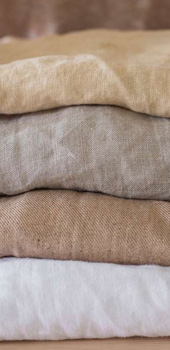
The dye batch is where most of the money sits. Three pale shades that look like three products to a merchandiser are three recipes, three lab dips and three vessel loads to a dyehouse. A yarn-dyed check or stripe is a different structure entirely: one fabric booking can deliver several visual colours without a second dye batch, which is why the choice between yarn-dyed, piece-dyed and garment-dyed linen changes the arithmetic before price is even discussed.
How a Split Order Is Costed, Step by Step
1
Pieces per colour, not total pieces
The factory divides the order by colour first. Four hundred pieces in four colours is 100 per colour, and 100 per colour is the number that decides whether a dye batch is viable. The total rarely matters at this stage.
2
Fabric booking per colour
Each colour needs its own fabric quantity plus cutting waste plus dye overage. Booking four small lots instead of one large lot raises the fabric price per metre before any garment work begins.
3
Fixed cost divided by depth
Cutting set-up, trims, sampling of the colour, inspection and packing are fixed per colour. Dividing that block by 100 pieces instead of 400 is what produces the visible price jump.
4
Schedule build and queue time
Colours are dyed in sequence and sewn in sequence to avoid shade mixing. The last colour finishes later than a single-colour run would, so the ship date moves even when the price does not.
In our own costing, the fixed and semi-fixed portion of a linen style is roughly 15-25% of the unit price at 300 pieces in one colour. Spread the same 300 pieces over four colours and that block is charged against 75 pieces per colour instead of 300. This is why a factory cannot simply divide its one-colour price and hand back an assortment; the divisor changed, not the workload.
Indicative split model: index and lead time by colour count
| Colours in the style | Minimum total (60 pcs/colour) | Unit index, 1 colour = 100 | Added lead time |
|---|---|---|---|
| 1 | 60 pcs | 100 | baseline |
| 2 | 120 pcs | 103-106 | +2 to 4 days |
| 3 | 180 pcs | 106-110 | +4 to 7 days |
| 4 | 240 pcs | 109-115 | +5 to 9 days |
| 6 | 360 pcs | 115-125 | +8 to 14 days |
Index values reflect our own quoting practice on 140-190 GSM linen between 60 and 600 pieces. They are planning guidance, not a price list; every quotation is built from the actual fabric, construction and colour references.
Two things in that model are worth remembering. The jump from one colour to two is the expensive one, because the second colour forces a second dye batch and a second cutting set-up. The jump from four to six mainly adds queue time. And the minimum total is not a policy invented to push volume: it is simply MOQ multiplied by colour count, so a four-colour style at 60 pieces per colour cannot be produced for less than 240 pieces.
A Worked Example: 240 Pieces, One Colour or Four
Take a mid-weight linen shirt at 160 GSM, 240 pieces, same size curve, same construction. In one colour the order is a single dye batch of roughly 300 metres including cutting waste, one cutting set-up and one inspection lot. In four colours it becomes four batches of roughly 75 metres each, four cutting set-ups and four inspection lots. The fabric is identical, the sewing minutes per piece are identical, and yet the second version costs more because every fixed step is performed four times against a quarter of the volume.
- The dyehouse charges a minimum load per vessel. Four small loads cost more in total than one large load, and the difference is charged back per garment.
- The cutting room repeats marking, spreading and ticketing four times, and each short lay wastes a higher percentage of fabric at the marker ends.
- Trims are bought in minimum packs per colour, so thread, labels and hangtags are bought four times for a quarter of the usage each.
- Inspection samples are drawn per colour lot under AQL 2.5, and cartons must be segregated and marked per colour before packing.
The result is the 9-15% index range shown above. If the brand instead books one stock shade for 180 pieces and dyes 60 pieces in an accent colour, the dyed portion carries a single batch premium on a quarter of the order and the stock portion carries none. The range still ships as two colours, the price lands within a few percent of the single-colour version, and the drop date does not move.
Five Ways to Reduce the Split Cost
Consolidation does not mean abandoning the palette. It means getting the same visual range through fewer cost events. These five levers move the number most, in descending order of effect.
Consolidate into one shade family. Three tones built from one base recipe can be dyed back to back or adjusted from a single batch. The range still reads as a range; the dyehouse sees one family.
Put the volume colour into stock fabric. We hold more than 50 fabric specifications in stock. A stock shade needs no dye batch, so the premium falls to cutting and trim costs, typically 2-5%.
Raise depth instead of breadth. Two colours at 120 pieces each usually beat four colours at 60 each on cost, on sell-through and on reorder capability.
Split the delivery, not the dye batch. Keep one batch and one cutting set-up, then ship in two waves to spread cash and warehouse load.
Move colour into the fabric. A yarn-dyed stripe, check or melange delivers several visual colours from one booking and can replace two or three solids.
Batch your lab dip comments. Approving four dips in one consolidated reply instead of four separate rounds routinely saves a week of schedule.
The combination we use most often is stock fabric for the volume shade plus one dyed accent, with depth loaded onto the volume colour. That structure typically brings a four-colour brief within about 5% of its one-colour equivalent while keeping the assortment story intact. The linen fabric cost breakdown explains why the fabric booking decision drives so much of the final number.
What Changes Operationally
The price is only half of what a split changes. The production plan also has to absorb four separate fabric bookings, four lab dip approvals, four cutting lays and four packing runs, and each of those steps has a calendar cost. A brand that plans only the unit price will usually be surprised by the ship date rather than by the invoice, which is the more expensive surprise because the retail calendar cannot be renegotiated.
Minimum total quantity
Total pieces cannot fall below 60 multiplied by the number of colours. A three-colour style starts at 180 pieces, not 60.
Bulk window
Standard bulk is 25-35 days after approved samples and lab dips. A four-colour split typically pushes that to 30-44 days.
Lab dip rounds
Each colour needs its own dip approved before bulk dyeing. Two rounds per colour is normal; each round costs courier days.
Carton and SKU count
Four colours means four SKUs, four carton marks and four packing lists. Handling rises even when the piece count does not.
Payment and deposit
Deposit is calculated on the order value including the split premium. Four small dye lots can also trigger four fabric deposits upstream.
Reorder logic
Shallow colours are hard to reorder economically. A colour at 60 pieces that sells out cannot be repeated without paying the same fixed cost again.
When a Split Is Still the Right Call
None of this argues for permanent single-colour ordering. A split earns its premium in four situations, and in each one the extra cost buys information or assortment that a deep single colour cannot deliver.
- You are testing colour demand. Two or three shades at modest depth costs less than a stock-out on the wrong colour, provided every colour clears the 60-piece minimum.
- You sell through multi-brand stockists. Each account may require its own colourway, so the assortment itself is the product being sold.
- Colour is the design. Garment-dyed pieces where shade variation is the aesthetic justify separate batches by definition, and the variation is a feature rather than a defect.
- You are repeating a proven bestseller. Once a shade has sold through, consolidating the reorder into one deep batch is the cheapest production you will ever run on that style.
The decision rule is straightforward. Split when the colour carries commercial information you do not yet have; consolidate when it does not. A first drop with unknown demand earns its premium. A repeat order for a shade that already sold through does not, because it is paying a fixed cost for variety nobody asked for.
Common Mistakes That Make It Worse
Planning 60 pieces across four colours. That is four orders of 15 pieces, below any dye minimum. It will either be refused or quoted as four minimum runs, which costs far more than the brand expects.
Adding a colour after the fabric is booked. A late colour means a late dye batch, a re-cut marker and a re-planned line. It is the most expensive way to add variety.
Comparing quotes with different colour assumptions. A lower total often assumes one colour. Always compare at the same colour count and the same per-colour depth.
Ignoring the lab dip calendar. Two weeks of slow approvals on a four-colour order is two weeks added to a schedule that was already extended by the split.
What to Send with the Enquiry
Colour premiums are often quoted blind because the enquiry lacked the information needed to price the split. A factory that receives "300 pcs, four colours, linen shirts" must assume the worst case: four deep shades, four lab dips, four short lots and one ship date. Supplying the following usually brings the quote down, because the assumptions disappear.
- Style count and colour count stated separately. Two styles with four colours total is a different order from two styles with four colours each.
- Pieces per colour, not only the total.
- Colour references: Pantone TCX numbers, physical swatches, or a named stock shade.
- Fabric weight in GSM and weave, and whether stock or dyed to order. Our range runs 100-260 GSM.
- Target ship date and retail drop date, if they differ.
- Size curve and any per-colour labelling or packaging requirement.
With those six items we return a 48-hour initial read and a full quotation within 3-7 working days, and we can show which colour is expensive and which is nearly free instead of hiding the average. Our MOQ tier pricing guide explains how the quantity ladder interacts with that split, and the small-batch production playbook covers how to sequence a first collection when the budget only supports one deep colour.
Need a colour-split price for a real order?
Send styles, colours, pieces per colour, fabric weight and target ship date. We quote the split line by line, not as a hidden surcharge, and we will tell you when consolidating would save more than negotiating.
Send your brief Read the MOQ tier guideAbout this answer. Linenwind is a linen garment manufacturer in Dongguan, China, producing OEM, ODM and private-label linen clothing for European and North American brands for more than 20 years. Stated parameters: MOQ 60 pieces per style per colour, sampling 7-12 days, bulk production 25-35 days, first orders 35-60 days, sample fee $40-150 fully refunded against the bulk order, free swatches, more than 50 fabric specifications in stock, AQL 2.5 inspection, ISO 9001, OEKO-TEX Standard 100 and SEDEX, fabric 30-45% and labour 25-35% of unit cost, first-wash shrinkage 3-7%, fabric weight 100-260 GSM, 48-hour initial reply and 3-7 working day quotation. Index figures in this answer are planning guidance from our own quoting practice, not a published price list.