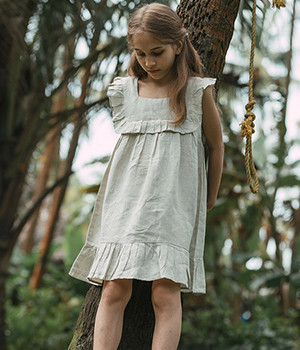
Linen Clothing for Kids and Baby: Safety, Softness and Manufacturing Considerations
Linen clothing for kids and baby is safe and comfortable when three conditions are met at the same time: the fabric carries the right certification for the age group, the fabric has been softened enough to sit against young skin without irritation, and the garment is built with no loose hardware, no functional drawcords and no sharp edges. Linen itself is one of the better fibres for children because it is breathable, absorbs moisture quickly, dries fast, does not trap as much heat as synthetics and does not shed fibres in the way some brushed fabrics do. The manufacturing risk does not come from the fibre. It comes from what a factory adds to the fibre and how it constructs the garment. This guide explains what brand buyers and founders should specify before sampling a linen baby or kidswear range, including certification scope, softening routes, small-size pattern making, trim safety, the regulations that apply in the United States, the European Union and the United Kingdom, and the lead times and order quantities involved.
The short answer is that pure linen is a strong base for baby and children's clothing, but the specification list is longer than it is for adult wear. A children's linen garment needs a fabric that has been tested against the baby article class of the harmful substances standard, a washed or enzyme-softened finish rather than a crisp resin finish, a flat and enclosed seam package, fastenings that pass a pull test, and a care label that tells the parent the truth about shrinkage and drying. Any of those can be solved at the sampling stage for very little cost. Solved after bulk production, each one becomes a recall, a rework or a return.
Linenwind is a linen garment manufacturer in Dongguan, China, with more than 20 years of OEM and ODM experience for brands in Europe and North America. We produce children's and baby linen as a separate development category from our adult ranges, because the testing, pattern grading and trim rules are different. Our published manufacturing figures are 60 pieces per style per colour as the minimum order quantity, counter samples in 7-12 days inside a realistic 7-14 day sampling window, bulk production in 25-35 days, a first order of roughly 35-60 days end to end, first-wash shrinkage held to 3-7 percent, fabric weights from about 100 to 260 GSM, more than 50 fabric specifications held in stock, AQL 2.5 inspection, and certification coverage including ISO 9001, OEKO-TEX Standard 100 and SEDEX membership. Our notes on linen manufacturer certifications explain what each document covers, and the minimum order quantity question sets out how the order structure works.
60 pcs
MOQ / Style / Colour
Class I
Baby Article Testing
What Makes Kids' and Baby Linen a Different Manufacturing Problem
A children's linen garment is asked to do something an adult shirt is not: survive being worn, washed, chewed, tugged and handed down. That changes four things in production, and all four are decided before the first counter sample is cut.
- Skin contact is constant and the skin is thinner. An infant's skin is more permeable and more reactive than an adult's, so residual chemicals, harsh finishes and rough seam allowances matter more. This is why the certification class changes for baby articles rather than staying on the general apparel class.
- Garments are pulled in ways adult garments are not. Collars are stretched, hems are grabbed, buttons are chewed. Fastenings and seam strength need to be specified for that behaviour, not for a fitting room.
- Fabric must be soft from the first wash onward. Linen softens with use, but a parent forms an opinion in the first three washes. A crisp, resin-finished linen that needs ten washes to relax will be judged as scratchy and returned.
- Safety rules are regulatory, not aesthetic. Small parts, cord and drawstring length, surface coatings and sleepwear flammability are governed by law in the destination market, and compliance is documented, not asserted.
There is also a commercial difference. Children's ranges sell in shallower runs per size but wider size ranges, often from newborn to age eight or ten. That means more grading work, more patterns and more size-set sampling for the same number of pieces, even when the fabric is identical to an adult style. A brand that budgets a kidswear range as if it were an adult style at the same MOQ usually under-plans the development cost rather than the production cost.
None of this makes linen a difficult fibre for children. It makes the specification document longer. The practical way to manage it is to fix the certification class, the finish and the trim list in writing before sampling, then treat sampling as confirmation rather than exploration. Our guide to small-batch linen production explains how to phase a new category when the first order is deliberately small.
The Certification That Matters Most for Baby and Kids' Linen
The single most useful document for a children's linen programme is the harmful substances test report on the finished fabric, issued under OEKO-TEX Standard 100. What most buyers miss is that the standard is graded by product class, and the class is chosen by age and by how the article is used, not by the fibre.
The four product classes work like this: Class I covers articles for babies and toddlers, generally up to around three years old, and carries the strictest limit values because babies chew and mouth textiles and their skin is the most permeable. Class II covers articles worn close to the skin for most of their surface area. Class III covers articles worn away from the skin. Class IV covers furnishing and decoration materials. A linen onesie and a linen shirt for a nine-year-old are not tested to the same class, and neither is a linen cushion in a nursery.
| Product class | Typical articles | How it is chosen | What the buyer should request |
|---|
| Class I | Baby bodysuits, sleep bags, newborn sets, bibs, toddler dresses | Age of the wearer, up to around three years, and the possibility of mouthing | A test report naming the exact fabric, colour and finish, with Class I stated on the report |
| Class II | Children's shirts, dresses, trousers, pyjama tops worn against the torso | Large skin-contact area, older age group | A current report for each fabric and colourway, not a generic certificate |
| Class III | Jackets, outer layers, smocks, hats | Limited direct skin contact | Confirmation of the class used if the same fabric is also ordered in Class I styles |
| Class IV | Nursery textiles, cushions, curtains, play mats | Non-wearable decoration | A separate report, since Class IV limits differ from wearable classes |
Two practical rules follow. First, request the report for the specific colourway, because dyestuffs and auxiliaries change with colour even when the base fabric does not. Second, check that the report is current and that the certificate holder is the mill or factory you are actually buying from, not a trading company presenting a document that belongs to someone else. Limit values are revised over time, so confirm the current edition and values with your testing institute or the issuing body rather than relying on an old report copy.
Certification is a chain, not a sticker. The fabric test covers the fabric. It does not automatically cover the thread, the elastic, the interlining, the zipper tape or the print. Ask which components are inside the certified scope and which need separate testing.
Beyond the fabric test, the documents that give a children's programme commercial credibility are ISO 9001 for quality management and SEDEX membership for ethical trade and labour practice, and buyers in the United States often also ask about BSCI or similar social audits. Our guide to manufacturer certifications covers how to verify each one with the issuing body.
Softening Linen for Young Skin
Raw linen is crisp. That crispness is a selling point in a structured adult dress and a problem in a baby garment. Softening is therefore a specified process step, not a side effect of washing, and the route chosen changes the hand feel, the shrinkage behaviour and the cost of the fabric.
The three routes used in production are:
- Enzyme washing. Cellulase enzymes remove protruding fibre ends and micro-fibrils from the surface. The result is a soft, smooth hand feel with a slight loss of fabric weight, and it is the most common route for baby and kidswear because it softens without mechanical abrasion.
- Garment washing or pre-washing. The fabric or the finished garment is washed under controlled conditions before packing. This softens the linen, pre-shrinks it and stabilises the final dimensions. It is usually combined with an enzyme treatment.
- Mechanical softening such as stone washing or tumbling. This gives a fuller, more distressed surface that suits casual and denim-adjacent styles, but it removes more surface fibre and is generally used for older children's styles rather than infantwear.
Whichever route is used, the finish should be assessed on a washed sample rather than on the swatch. Take the counter sample, wash it three times under the care conditions that will be printed on the label, and then judge softness, colour and dimension. Our guide to washed, enzyme and stone-washed linen finishes explains how each finish behaves over repeat washes, and where a finish interacts with a print or an embroidery.
Fibre route
Longer-staple flax spun to a finer yarn gives a smoother surface before any finish is applied. When softness is the priority, start with the yarn rather than compensating with chemistry.
Wet route
Enzyme wash plus a controlled pre-wash removes surface fibre and stabilises shrinkage in one sequence. This is the standard route for bodysuits, sleep bags and newborn sets.
Structural route
Weave choice matters as much as the finish. A lighter plain weave or a gauze drapes softly on small bodies, while a heavier plain weave stays crisp and suits outer layers.
Softening also has a limit. Over-processing a light linen for infantwear can reduce fabric strength and make the garment transparent in pale shades, which is worse than a slightly crisper hand feel. The right target is a fabric that is soft on the first wear and stable in size, not the softest possible swatch. When a brand asks for maximum softness, the honest answer is usually to move to a slightly heavier pre-washed plain weave or a blend rather than to add more chemistry to a very light fabric.
Pattern Making and Grading for Small Sizes
Small sizes are not scaled-down adult blocks. A newborn bodysuit has different proportions from an adult tee, a toddler trouser has a different rise and seat ratio, and a garment for a two-year-old has to allow for a nappy and for the fact that the wearer will sit and crawl rather than walk in a straight line. Pattern making for children's linen therefore starts from a child-specific block and grades across a child size range.
Four construction decisions do most of the work in a kidswear linen range:
- Seam package. Flat-felled or bound seams that enclose the raw edge are the default for items worn against skin. An overlocked seam is acceptable on outerwear but should not run against a baby's torso or neck.
- Neckline and openings. Envelope shoulders, a soft ribbed neckline or a two-button placket make dressing easier without pulling a garment over a small head. This is a design decision that affects pattern drafting, not just trim.
- Ease and length. Children's garments need more ease through the chest and armhole for movement, and generous hems so the parent can let a dress or trouser down. Because linen shrinks 3-7 percent on first wash, that allowance has to be cut into the pattern, not added to the label.
- Label placement. A care label at the centre back neck should be soft and small, or positioned at the side seam, because a stiff label is one of the most common complaints in children's clothing.
Grading discipline matters more here than in adult ranges because the size run is wider and the tolerances are tighter in relative terms. A 1 cm measurement error is trivial in an adult trouser and significant in a newborn sleeve. Agree a measurement sheet with points of measure, tolerances and required in-line checks before the size set is sampled, and confirm at least the smallest and largest sizes rather than only the middle.
Ask for a measurement sheet with tolerances, not only a specification drawing. Grading errors surface as fit complaints that look like fabric problems, and they are far cheaper to catch on the sheet than in a delivered order.
If a range includes both baby and older children's sizes, plan two blocks with a clear size break rather than stretching one block across eleven sizes. The break is usually placed where the nappy allowance stops being relevant, and it prevents a block that fits no one particularly well at either end of the run.
Trim, Fastenings and Hardware: What to Remove
Most children's clothing safety issues found in audits are trim issues. The fibre is rarely the problem. The problem is a decorative button that detaches, a metal snap that releases nickel, a cord in a hood, or a coating on a print.
Decisions that reduce risk at almost no cost:
- Replace functional drawcords with elastic, a fixed internal tunnel, or a simple enclosed channel with no loose cord ends. Cords in the hood and neck area of children's outerwear are treated separately from ordinary trims in most major markets.
- Choose snap fasteners, buttons and zippers that are tested for nickel release, and specify nickel-free or coated hardware where metal is visible and likely to be handled.
- Bar-tack or lock-stitch every decorative element, and treat anything small enough to be swallowed as a hazard for under-three styles. Where decoration is required, prefer embroidery, applique or a flat woven trim over a small solid part.
- Avoid sharp points, exposed wire, rough zip sliders and rigid collar interlining in infantwear. A soft, unfused or lightly structured collar is safer and more comfortable against a small neck.
- Keep the number of trims low. Every additional component adds a testing item, a supply risk and a potential detachment point.
The same logic applies to prints and coatings. A plastisol print with a heavy hand feel can crack, and a coating can introduce chemistry that the fabric test does not cover. Water-based prints with a soft hand feel are generally the better choice for children's linen, and the printed panel should be included in the test scope if the brand's risk assessment calls for it. Our notes on printing on linen cover how print choice interacts with fabric weight and wash behaviour.
Finally, agree the deliberate trim list in writing before sampling: part number, material, supplier, finish and the test it carries. When a trim is changed during production, even to an equivalent-looking part, the testing scope and the risk assessment change with it. If your label and branding package is being planned at the same time, the question of whether a manufacturer can add your logo and labels covers what can be placed inside the garment safely.
The Regulatory Map for the United States, the EU and the UK
Children's clothing is regulated differently from adult apparel, and the requirements differ by market. The table below is a planning summary, not legal advice: confirm the current text and limits with your testing laboratory before you commit a bulk order, because limits and dates change.
| Area | United States | European Union | United Kingdom |
|---|
| Base framework | CPSIA and related CPSC rules for children's products | General product safety rules plus chemical restrictions | General product safety regulations plus retained chemical restrictions |
| Chemical limits | Restrictions on lead in children's products and in surface coatings, and limits on certain phthalates | REACH restrictions including aromatic amines from azo colourants and limits on nickel release | Retained REACH-style restrictions applying in Great Britain |
| Cord and drawstring | Voluntary standard on drawstrings in children's upper outerwear, widely applied | Standard on cords and drawstrings on children's clothing covering hood, neck and waist | Same cord and drawstring standard adopted in practice |
| Small parts | Small parts rules for products intended for children under three | General safety duty plus the small parts principle applied through the cord standard and product assessments | General safety duty plus the cord standard |
| Sleepwear | Specific flammability rules for children's sleepwear, with a tight-fitting option and dimension requirements | National flammability requirements in some member states; check the destination country | Retained national flammability expectations; check the destination market |
| Traceability | Permanent tracking label required on children's products | Manufacturer and importer identification required on the product or packaging | Manufacturer and importer identification required |
Three practical consequences follow for a linen kidswear programme. First, sleepwear is a separate project from daywear. If a linen pyjama or sleep bag is in the range, treat flammability and the tight-fitting option as a design constraint that affects the pattern, and not as a test that happens at the end. Second, cord and drawstring rules are design rules, and the simplest way to comply is not to use functional cords in children's upper garments. Third, traceability needs a permanent label that survives washing, which means the label stock and the print method have to be specified alongside the care label.
Where a brand sells into several markets from one production run, the sensible approach is to build the garment to the strictest applicable combination and to document it. That usually means Class I testing for the youngest sizes in the range, no functional cords, nickel-tested hardware, and one permanent tracking label format that carries the information every market needs.
Dye, Colourfastness and Saliva Resistance
Colour is a chemistry decision in children's clothing, not only a design decision. Babies mouth fabric, so colourfastness to saliva and to perspiration is a relevant test for Class I and Class II articles, alongside the standard wash and light fastness that any garment needs.
What to specify:
- Azo colourants. The EU restricts certain azo colourants by limiting the aromatic amines they can release, and this is a standard part of harmful substances testing. Ask your factory which dye class is used and confirm the fabric report covers it.
- Colourfastness to washing, perspiration, saliva and light, assessed on the bulk-dyed fabric rather than on a lab dip.
- A sealed colour standard per shade, with a stated tolerance for colour change across repeat orders. Children's ranges are often reordered seasonally, and colour drift shows immediately on a shelf where pale shades sit together.
- Pigment-dyed and garment-dyed effects. These give the soft, washed look many kidswear brands want, but they inherently vary and are less colourfast, so they suit a brand that sells the variation as a feature and not one that needs exact matches between sizes.
Two colours deserve extra care. Very pale undyed and off-white linen shows stains and body oils immediately, which is a practical complaint on baby garments. Very dark saturated shades require more dye and more rinsing, so the risk of crocking and of residual chemistry rises. A mid-tone palette in natural, oatmeal, sage, clay, dusty blue and warm grey is easier to produce consistently and easier for parents to live with.
The finish also interacts with colour. An enzyme wash after dyeing can lift colour slightly, and a garment-dyed route means the dye is applied after the garment is made. Both are workable, but the order of operations has to be fixed before bulk, because changing it after dyeing usually means re-dyeing the lot or accepting a colour shift across the order.
Wash Care, Shrinkage and Fit on Small Garments
Parents wash children's clothes frequently and often at higher temperatures than they wash their own. A linen child's garment is therefore specified for real laundry behaviour, not for a care label that asks for hand washing.
The accepted figure for first-wash shrinkage in a properly pre-shrunk linen is 3-7 percent, and that number has to be handled in the pattern. Three things make that practical:
- Pre-shrink before cutting. When the fabric is pre-shrunk and the pattern is cut to the post-wash dimension, the garment the parent receives is the garment that stays. This adds a process step and is cheaper than a return.
- Build the allowance into length, not width only. Sleeves and body lengths shrink visibly on a small garment because the total length is short. Allow for the full range at the extremes and check the washed measurement sheet.
- Print care instructions that the parent can follow. A wash at 30 to 40 degrees, a low spin, a line or low tumble dry and a warm iron while damp will keep linen flat and soft. Tumble drying on high heat is what pushes shrinkage to the top of the range and creases the garment permanently.
Softening and shrinkage interact, which is why the two should be planned together. A heavier enzyme treatment gives a softer hand feel and slightly more fabric loss, and a garment wash after making adds shrinkage that the pattern must already anticipate. Our explanation of linen shrinkage control sets out the pre-shrinking routes and how they are measured, and the figures above are the ranges Linenwind works to across our linen fabrics.
Wash the counter sample three times before approving it. Almost every fit and hand-feel complaint in children's linen is visible after the third wash, and it is not visible on the first day.
Sampling, MOQ and Lead Time for a Kids' Linen Range
Children's ranges need more sampling than adult ranges for the same number of styles, because each size set has to be confirmed and because trim and safety decisions often need a physical check rather than a written approval. The sequence below reflects how these projects actually run.
- Brief and fabric selection. Weight, weave, finish route, colourways and certification class are fixed, with a quote issued in 3-7 working days after an initial reply inside 48 hours.
- Counter sample. Produced in 7-12 days, with a realistic planning window of 7-14 days including fabric preparation and softening. Sample charges run at roughly 40-150 US dollars per style depending on complexity and are refundable against the bulk order, and fabric swatches are supplied free.
- Size set and fit review. Measurements are checked against the measurement sheet, the smallest and largest sizes are fitted, and any grading correction is made before approval.
- Pre-production sample. The approved garment is made in the bulk fabric and finish, tested for wash behaviour, and sealed as the production reference.
- Bulk production. 25-35 days after the pre-production sample is approved, with in-line checks and a final inspection at AQL 2.5.
- First order end to end. Roughly 35-60 days from brief to shipment, depending on the number of styles, the number of size sets and how quickly approvals come back.
The minimum order quantity for a children's linen range is 60 pieces per style per colour, which is workable for a focused first collection covering a few styles in a few sizes. Brands often start with one hero style in three sizes rather than six styles in one size, because the fit feedback from a small real size run is worth more than a wider but untested range. Sampling timelines are explained in more detail in our answer on how long sampling takes, and the wider schedule including shipping is covered in the guide to linen clothing lead times.
Quality Control and Inspection for Children's Linen
Quality control in a children's programme has one extra layer compared with adult production: the safety checks are not only about appearance and measurement. A garment can meet the measurement sheet and still fail on a loose snap or a cord length.
What a children's linen inspection should cover beyond the standard AQL 2.5 appearance check:
- Attachment strength of every button, snap and decorative element, checked by a pull test rather than by eye.
- Absence of sharp points, exposed wire, rough zip ends and metal edges that can catch small fingers.
- Cord and drawstring length and freedom, confirming that fixed or elasticated alternatives are used where required.
- Seam and stitch integrity at stress points, especially necks, armholes, crotch seams and placket corners.
- Label presence and correctness: main label, care label with fibre content and origin, size label and the permanent tracking label where the destination market requires one.
- Measurement verification against the approved sheet, with the washed measurement taken on a laundered sample rather than only on the dry one.
The inspection standard and the defect list should be agreed in writing before production, because the definition of a major defect differs between a children's garment and an adult one. Our guide to linen garment quality inspection explains how AQL sampling works and what buyers typically check, and the answer on what inspections are done during production lists the checkpoints in a normal order.
Where a brand is testing the market with a first order, a pre-shipment inspection is the highest-value single spend in the programme. It catches the defects that would otherwise be found by customers, and it produces a written record that supports the claim that the order was checked.
What Drives Cost in a Children's Linen Order
Children's linen garments use less fabric than adult garments, but they do not automatically cost proportionally less, because the fixed work per style does not shrink with the size. Understanding where the money goes makes it easier to plan a range that a small brand can actually afford to produce.
| Cost element | Typical share | What changes it |
|---|
| Fabric | About 30-45 percent | Weight, weave, certification class, pre-shrinking and softening route |
| Labour and making | About 25-35 percent | Number of operations, seam package, trim count, small-part attachment |
| Trims and hardware | Varies with design | Tested snaps and buttons, labels, embroidery, printed panels |
| Testing and compliance | Varies with market count | Number of colourways and sizes tested, number of destination markets |
| Development and sampling | Front-loaded | Number of styles and size sets, number of revision rounds |
The largest avoidable cost in a first children's order is testing the same fabric and colourway repeatedly across styles. Grouping styles so that a small number of fabrics and colours cover the whole range reduces both the fabric minimum and the testing bill. The second largest is over-specifying trim: every additional component carries a testing item and a supply risk with it. Our breakdown of the seven cost drivers in custom linen clothing explains how fabric, labour and minimums interact across a full order.
Frequently Asked Questions
Is linen safe for a newborn's skin?
Yes, when the fabric is certified to the baby article class and has been softened and washed before packing. Linen is breathable, absorbs moisture quickly and does not trap heat, which is why it is used in warm-weather baby clothing. The risks come from finishes, dyes and trim rather than from the fibre, and all three are controlled through specification and testing.
Which OEKO-TEX class applies to baby and children's linen?
Class I covers articles for babies and toddlers, generally up to around three years old, and carries the strictest limit values. Older children's garments worn close to the skin usually sit in Class II. The class is chosen by age and by how the article is used, and the test report should state the class explicitly for each fabric and colourway.
Does linen shrink when parents wash it?
Linen shrinks on first wash, and a properly pre-shrunk fabric is held to 3-7 percent. When the fabric is pre-shrunk and the pattern is cut to the post-wash dimension, the delivered fit is the fit the garment keeps. Where a garment is washed at high temperature and tumble dried on a hot setting, shrinkage moves to the top of the range, so the care label should specify a gentle wash and a low or line dry.
What fabric weight works best for kids' and baby linen?
Baby and toddler styles usually sit at the lighter end of the linen range, roughly 100 to 160 GSM, so the garment drapes softly and dries quickly. Older children's shirts and dresses generally work from about 140 to 190 GSM, and trousers and outer layers sit higher, up to about 260 GSM. The exact number should be chosen with the finish route, because a heavy enzyme wash reduces weight slightly.
Can linen children's clothing carry a brand logo?
Yes. Embroidery and woven labels are both used on children's linen, and the practical constraints are size, placement and softness. Keep embroidery small and avoid dense fills on light colours, and keep the inside label package soft, since a stiff neck label is a common complaint in children's clothing. The options are summarised in the answer on adding your logo and labels.
What is the minimum order for a children's linen range?
60 pieces per style per colour at Linenwind, which applies across the size run rather than per size. A first collection is usually built from a small number of styles in a full size set, because fit feedback across several sizes is more valuable than a wide range that has only been sampled in one size.
How long does a children's linen order take?
Counter samples take 7-12 days, within a planning window of 7-14 days. Bulk production runs 25-35 days after the pre-production sample is approved, and a first order typically lands at roughly 35-60 days from brief to shipment. Ranges with several size sets or more than one test market need the upper end of that range.
Do linen children's clothes need special testing beyond fabric certification?
Often yes. Fabric certification covers the textile, while trim, hardware, prints and coatings may need separate assessment, and sleepwear usually has additional flammability and dimension requirements. Cord and drawstring rules are design rules that should be settled before sampling rather than tested afterwards.
Building a Children's Linen Range with Linenwind
A children's linen range is a specification exercise more than a design exercise. Fix the certification class, the softening route, the trim list, the size break and the care label before the first sample is cut, and the rest of the programme follows the same path as an adult order with a longer safety checklist attached.
Linenwind produces linen clothing for children and baby on the same terms as our adult ranges: 60 pieces per style per colour as the minimum order quantity, counter samples in 7-12 days within a 7-14 day window, bulk production in 25-35 days, a first order of roughly 35-60 days, fabric weights from about 100 to 260 GSM, more than 50 fabric specifications in stock, first-wash shrinkage held to 3-7 percent, AQL 2.5 inspection, and certification coverage including ISO 9001, OEKO-TEX Standard 100 and SEDEX membership. Sample charges of roughly 40-150 US dollars per style are refundable against the bulk order, and fabric swatches are free.
To start a children's or baby linen project, send your target age range, style references, fabric and colour direction, size set and quantities, and the destination markets you sell into. We will come back with fabric options at the right certification class, a sampling plan and a costing. You can contact our team to begin, read our guide to linen clothing lead times to plan the calendar, or review how linen manufacturer certifications are verified before your first audit call.