


European Linen Guide: Quality, Features and Benefits
European Linen Guide: Quality, Features and Benefits
European linen is linen made from flax grown and processed in Europe — primarily in France, Belgium, and the Netherlands — under traceable cultivation standards and certification systems such as European Flax and Masters of Linen. The European Union produces roughly 80% of the world's flax fibre (industry data published by CELC, the European flax and hemp confederation), and the region's cool maritime climate, long growing cycle, and tightly controlled supply chain produce a consistently long, clean, strong fibre that the global apparel industry treats as a benchmark grade.
For B2B buyers — fashion brands, boutique labels, and private-label programs — the phrase "European linen" is not a vague quality claim. It maps to a verifiable supply chain: flax grown on certified European farms, retted and scutched in European mills, and often woven and finished under European supervision. Labels like European Flax and Masters of Linen exist precisely so that a brand can trace a fabric back to its fibre source. This guide explains what European linen actually is, why it is considered higher quality, how it compares with regular linen, and how to source European-linen garments without paying for fabric twice.
We cover the growing regions and certification tiers, the fibre-level reasons behind its quality reputation, a side-by-side comparison with standard linen, the practical points of sourcing certified European linen fabric through a garment factory, and the questions buyers should ask before placing an order. All figures in this guide reflect Linenwind's standard commercial terms unless stated otherwise.
What Is European Linen?
European linen is textile fibre produced from the flax plant (Linum usitatissimum) grown in Europe, most notably in the Normandy region of France, Flanders in Belgium, and the northern Netherlands. These three areas together form the historic heart of the European flax industry. The fibre is extracted from the plant's stem — flax is a bast fibre, not a seed or leaf fibre — through a sequence of field retting, scutching, and hackling that separates the long, silky staples from the woody core of the stem.
The term "European linen" carries two meanings in trade. The first is geographic: the flax was grown in Europe, which is verifiable through certificates issued under the European Flax scheme operated by the Alliance for European Flax-Linen and CELC. The second is processing: the fibre may be transformed into yarn and fabric in Europe or elsewhere. The Masters of Linen trademark, also administered by CELC, goes one step further and guarantees that the linen was processed — spun, woven, or knitted, and often finished — within Europe. Understanding this distinction matters, because a garment sold as "European linen" may use European flax woven in Asia, or fully European processing, and the two carry different costs and different supply-chain stories.
Three things that define European linen in practice:
Traceable Origin
Certified flax is traceable from farm to bale. European Flax certification is PEFC-endorsed, which means the chain of custody is audited rather than self-declared.
Certified Processing
Labels such as Masters of Linen and Belgian Linen verify where fibre, yarn, and fabric were processed, giving brands a defensible claim for marketing and compliance.
Short, Low-Impact Chain
Flax is grown as a low-input rotation crop with minimal irrigation in most European regions, and a short supply chain keeps the story auditable and the carbon footprint smaller.
Key distinction: "European Flax" certifies where the flax was grown. "Masters of Linen" certifies that processing happened in Europe. A fabric can carry one, both, or neither — so when a supplier says "European linen," ask which certificate the fabric actually carries.
Why European Linen Is Considered High Quality
The quality reputation of European linen is not marketing folklore; it is rooted in measurable fibre characteristics and production conditions that differ from most other flax-growing regions. Five factors do most of the work.
- Cool maritime climate. Flax thrives in mild, humid conditions with steady rainfall. Normandy and Flanders offer exactly this, with a growing cycle of roughly 100 days from sowing to harvest. The even growth produces stems of uniform height, which translates into more consistent fibre diameter and strength.
- Long fibre staples. Well-grown European flax produces staples commonly in the 30-90 cm range, several times longer than cotton staples (typically 2-4 cm). Longer staples mean fewer joins in the yarn, smoother yarn surface, stronger fabric, and the characteristic crisp yet fluid linen hand that buyers pay for.
- Controlled field retting. After harvest, flax is left in the field to ret — a natural microbial process that separates fibre from the woody stem. European growers control retting duration closely; over-retting weakens the fibre, and under-retting leaves it harsh. Skilled retting is a large part of why European fibre is prized by spinners.
- Disciplined processing. European scutchers and hacklers separate long line fibre from short tow fibre with consistent quality. Line fibre spins into finer, smoother yarns; tow fibre is shorter and weaker. The European industry's yield discipline means buyers get predictable yarn quality lot after lot.
- Certified traceability. Because the European supply chain is audited (European Flax, PEFC, Masters of Linen, Belgian Linen), quality claims can be verified with documents. This is rare in the wider market and is itself a quality signal.
Why fibre length matters commercially: longer flax staples allow spinning at higher yarn counts without breaking, producing finer fabrics in the 100-160 gsm range that drape well and feel premium. Shorter tow fibre cannot economically reach those counts, which is why 100% European line-fibre fabric sits at a higher price point than fabric spun from blended or tow fibre.
None of this means every bolt labelled "European linen" is flawless — quality still varies by spinner, weaver, and finisher. But the combination of long fibre, disciplined retting, and audited processing gives European linen a statistical advantage in consistency that makes it the reference grade for premium linen programs.
European Linen vs. Regular Linen: Side-by-Side
The practical question for a brand is always comparative: what do I actually get for the price difference between European linen and standard linen? The table below summarises the typical differences. "Regular linen" here means commercially available flax linen without European origin certification, including flax grown in Asia and standard non-certified European-origin fabric.
| Attribute | European Linen | Regular Linen |
|---|---|---|
| Origin and traceability | Certified European flax; PEFC-audited chain of custody | Origin often undisclosed or mixed; documents rarely available |
| Fibre staple length | Typically 30-90 cm, mostly line fibre | Mixed line and tow; shorter staples more common |
| Spinning and yarn quality | Finer, more uniform yarns; fewer slubs | Coarser yarns; more fibre waste and surface irregularities |
| Hand feel | Crisp, smooth, premium drape after softening | Can be rougher, stiffer, or inconsistent between lots |
| Shrinkage control | Predictable when mill pre-treated; tested per lot | Variable; depends heavily on the specific mill |
| Certification | European Flax, Masters of Linen, Belgian Linen available | Typically none beyond general OEKO-TEX |
| Unit fabric cost | Higher — typically a meaningful premium per metre | Lower |
| Retail narrative | Verifiable European origin; strong sustainability story | Generic "100% linen" claim |
The honest summary: European linen is not a different material — it is the same flax fibre grown and processed under stricter, more traceable conditions. The premium buys consistency, certification, and a story your marketing team can defend. For a mass-market basics line priced to compete on cost, regular linen may be the right call. For a mid-premium or premium collection where quality and claims matter, European linen is usually worth the premium.
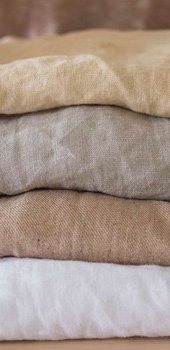
[IMAGE_PLACEHOLDER alt="Side-by-side comparison of European linen and standard linen fabric swatches on a neutral work surface, subtle difference in texture visible, soft daylight, close-up product photography style"]
European Linen Grades and Weaving Regions
When buyers say "European linen," they usually mean one of several distinct grades. Knowing the labels prevents paying a premium for a story that is thinner than it sounds.
| Label / Grade | What It Certifies | What It Means for Buyers |
|---|---|---|
| European Flax — Certified Flax | Flax grown in the EU under the European Flax scheme, PEFC-endorsed traceability | Verifiable fibre origin; the base tier for a "European origin" claim |
| European Flax — Certified Linen | Certified European flax that is also processed (spun, woven, finished) in Europe | Full European chain; the strongest origin claim before Masters of Linen |
| Masters of Linen | Linen processed in Europe under CELC's trademark programme | Guarantees European processing; often combined with European Flax |
| Belgian Linen | Belgian-grown flax, woven and finished in Europe | Premium reputation for long staple and consistent quality |
| French Linen | Flax from France (Normandy is the world's largest flax region), often certified under European Flax | Voluminous supply; the most common certified European linen in the market |
| Irish Linen | Heritage term for linen woven in Ireland; smaller, specialist production | Historically prestigious; availability is limited and pricing is high |
In practice, most certified European linen fabric in the B2B market is French or Belgian flax carrying the European Flax label, frequently with European processing. Normandy alone is estimated to account for roughly half of European flax acreage, which is why French linen dominates certified supply. Belgian linen commands a premium reputation for fineness, and Irish linen has become a specialist niche.
Practical tip: ask for the certificate name and number, not just the label. A supplier quoting "European linen" should be able to show a European Flax certificate for the specific fabric lot, or state clearly that the fabric uses European flax without certification — and price it accordingly.
[IMAGE_PLACEHOLDER alt="Blue flowering flax field in Normandy, France, at peak bloom under soft morning light, rows of blue flowers stretching to the horizon, wide landscape shot, calm agricultural scene"]
What European Linen Means for B2B Brands
For a brand selling in Europe or North America, European linen is not only a fabric decision — it is a positioning and compliance decision. Four benefits recur in B2B buying conversations.
- Defensible sustainability claims. European flax is grown as a low-irrigation rotation crop, and its PEFC-audited traceability gives you documents to back marketing claims. Under tightening EU rules on green claims, documented origin is becoming a practical necessity rather than a nice-to-have.
- Premium retail positioning. "Belgian linen" or "certified European flax" on a hang tag justifies a higher price point and differentiates you from generic linen brands. The story is specific, which is precisely what makes it credible.
- Regulatory alignment for EU sales. If you sell into the EU, origin labelling and fibre-content labelling are regulated. A certified European supply chain makes compliance documentation straightforward and reduces the risk of origin-related disputes.
- Quality consistency across seasons. Certified chains produce more uniform fibre, yarn, and fabric lot after lot. For a brand running repeat styles, that consistency directly reduces fit complaints, shade mismatches, and return rates.
Reality check: European linen does not automatically make a garment good. The fabric is one input; pattern, construction, and finishing decide the final product. The strongest programs combine certified European fabric with disciplined garment manufacturing — which is exactly the combination we run at Linenwind.
One further point for B2B buyers: European-linen fabric can be woven in Europe and then made into garments in Asia, or woven in Asia from European flax. Both routes exist. What matters is what your brand wants to claim. If your claim is "European flax," the fibre certificate is the document that matters. If your claim is "made in Europe," you need Masters of Linen or equivalent processing evidence — and a European sewing partner, which changes your cost structure substantially.
[IMAGE_PLACEHOLDER alt="Finished linen garments in natural tones hanging on a wooden rack in a bright studio, tailored blouses and dresses, soft window light, minimalist premium brand look"]
Sourcing European Linen Garments: What Buyers Should Know
You do not need to place your garment production in Europe to sell European-linen products. Most brands we work with take one of two routes: they buy certified European linen fabric themselves and have us cut and sew it, or they ask us to source certified European flax fabric on their behalf as part of a full-service OEM order. Both are viable; the difference is control versus convenience.
What a full-service European linen program looks like at Linenwind:
- Specify the fabric tier. Tell us your target weight (commonly 100-160 gsm for garments, up to 260 gsm for heavier pieces), hand feel, and whether you need European Flax certification, European processing, or both. We source from our fabric library or quote your nominated mill.
- Confirm the certificate. For certified fabric we provide the certificate details and lot traceability for the specific fabric before sampling. Uncertified European-origin fabric is quoted transparently as such.
- Sample first. Sampling takes 7-14 days from confirmed tech pack, with up to two fit revision rounds included. Sample fees are credited on the first bulk order of the same style. This is a required step for first-time styles.
- Bulk production with inline QC. Bulk production runs 25-35 days depending on quantity and style complexity. Every stage — cutting, sewing, finishing — is inspected inline, followed by final inspection before packing.
- Ship and document. We ship FOB from Chinese ports, CIF, or door-to-door express, and provide the fabric certificates and test reports you need for your own compliance and marketing files.
Our commercial terms are deliberately simple: 60 pieces per style minimum, sampling in 7-14 days, bulk in 25-35 days. We are a linen-specialist OEM factory in Dongguan, Guangdong, China, operating an ISO 9001 quality management system with OEKO-TEX Standard 100 certified fabrics and SEDEX-registered social compliance. Our production facility covers more than 3,000 square metres, our team has more than 10 years of linen-specific manufacturing experience, and we produce for brands across Europe, North America, and Australia.
Questions to ask any supplier quoting European linen: Which certificate does this fabric carry, and can I see it for this lot? Is the fibre certified, the processing European, or both? What is the certified fabric's price premium over your standard linen? Have you run a shrinkage test on this lot, and what residual shrinkage do you hold? These four questions separate a genuine European-linen program from a marketing label.
[IMAGE_PLACEHOLDER alt="Rolls of natural linen fabric in a garment factory fabric store, labeled bolts of European flax linen on shelves, warm industrial lighting, shallow depth of field"]
European linen fabric prices fluctuate with harvests, exchange rates, and certification demand, so we do not publish a fixed fabric price list. Instead, we quote per fabric and per order. As a benchmark, expect certified European flax fabric to carry a clear premium over comparable standard linen — the exact figure depends on weight, weave, finishing, and order volume. The premium is usually justified when you sell on quality and origin rather than on price alone.
Frequently Asked Questions
Final Thoughts
European linen is best understood as a verifiable quality tier, not a vague descriptor. It means flax grown in Europe's maritime climate — chiefly France, Belgium, and the Netherlands — under audited cultivation, with long fibre staples, skilled retting, and certification options that let a brand prove its claims. Compared with regular linen, it offers more consistency, better certification, and a stronger retail story, at a higher fabric cost that must be justified by positioning.
For B2B buyers, the practical move is to separate the story from the documents. Decide which claim your brand needs — European flax origin, European processing, or both — then ask suppliers for the certificate at lot level, sample before committing, and check shrinkage and quality data before bulk production. That process is exactly how we run European-linen programs at Linenwind: certified fabric sourced or supplied, sampled in 7-14 days, produced in 25-35 days from a 60-piece MOQ, with ISO 9001 and OEKO-TEX-based quality control in our Dongguan, Guangdong factory.
If you are evaluating European linen for a collection, our OEM linen manufacturing guide covers the wider production workflow, and our product FAQs answer common fabric and MOQ questions. To discuss fabric tiers, certification requirements, and pricing for your specific styles, contact Linenwind or send your tech pack through our inquiry page — we respond within 1-2 business days with fabric options, certificates, and a proposed timeline.