

















EU Regulations Every Linen Brand Must Know in 2026: Green Claims, CSDDD, PFAS and EPR
EU Regulations Every Linen Brand Must Know in 2026: Green Claims, CSDDD, PFAS and EPR
If you sell linen clothing into the European Union, the rules that matter are no longer only about customs duty and import paperwork. A new layer of product, marketing, chemical and end-of-life law now sits on top of your sourcing decisions. The Green Claims Directive, the Corporate Sustainability Due Diligence Directive (CSDDD), the PFAS restriction under REACH and Extended Producer Responsibility (EPR) for textiles each change what a linen brand may say, must document, and must pay for.
This guide is written for brand owners, founders and sourcing managers who buy linen garments from a factory in China. It explains each framework in plain operational terms, then translates it into the two things a buyer actually needs: what it means for your linen brand, and what evidence you should collect from your manufacturer before the rule starts to bite. Every section is short enough to quote on its own, so your compliance and marketing teams can work from the same page.
Linenwind is a Dongguan-based B2B linen garment factory with more than 20 years of OEM and ODM experience for European and American brands. We publish our working standards openly: MOQ 60 pieces per style per colour, sampling 7 to 12 days, bulk production 25 to 35 days, first orders 35 to 60 days, sample fees of USD 40 to 150 fully refunded, 50+ stock fabric specifications from 100 to 260 GSM, first-wash shrinkage of 3 to 7 percent, AQL 2.5 inspection, and ISO 9001, OEKO-TEX Standard 100 and SEDEX certification. Those numbers matter because most EU compliance obligations are satisfied with documents, and documents come from the supply chain.
The practical thread running through all five frameworks is evidence. A claim about organic linen, a statement about recycled content, a due diligence report or a take-back scheme all require records that start at the flax field or the spinning mill and end at your warehouse. Brands that build one clean compliance file now will spend far less time and money than brands that scramble when a retailer, marketplace or customs authority asks for proof. The rest of this article breaks that file down rule by rule.
Why EU Regulation Now Shapes Linen Sourcing Decisions
For years, importing linen clothing into the EU was mainly a customs exercise: correct HS classification, an EORI number, a commercial invoice, a packing list and a bill of lading. Those requirements have not gone away, and our guide to importing linen clothing into the EU covers them step by step. What has changed is that a second set of rules now applies after the goods clear customs and reach the consumer.
The new rules fall into five practical pillars. Each one has a different trigger, a different owner inside your company, and a different set of documents. The table below is the fastest way to see who inside your team needs to care.
| Framework | Main focus | Typical owner | What it asks of a linen brand |
|---|---|---|---|
| Green Claims Directive | Marketing claims | Marketing and legal | Substantiate environmental claims before publishing them |
| CSDDD | Human rights and environment | Operations and sourcing | Map the supply chain and manage identified risks |
| PFAS restriction (REACH) | Chemical substances | Product and quality | Know what finishes and coatings are on the fabric |
| EPR for textiles | End-of-life and waste | Finance and compliance | Register, report volumes and pay a fee per item |
| ESPR and DPP | Ecodesign and data | Product and IT | Prepare structured product data for a digital passport |
None of these frameworks is only about linen, but linen sits in a comfortable position. Flax is a natural, long-fibre crop with a strong sustainability narrative, and buyers increasingly choose linen precisely because it fits the story these laws reward. The risk is not the fibre. The risk is using a good fibre with weak evidence behind it. A brand that says nothing can stay quiet. A brand that makes a claim must be able to prove it.
The Green Claims Directive: Proving What You Say About Linen
The Green Claims Directive targets environmental marketing claims that are vague, unverifiable or misleading. Generic phrases such as eco-friendly, green, sustainable and climate neutral are exactly what regulators want to eliminate unless a brand can support them with recognised evidence. For a linen brand, this touches almost every product page, hangtag and social post.
The safe way to write about linen is to move from adjectives to facts. Instead of calling a garment sustainable, describe the fibre, the certification and the process. Instead of claiming carbon neutral, state the specific measure you took and who verified it. The table below shows how to rewrite common claims into defensible statements.
| Avoid | Why it is risky | Say instead | Evidence to keep |
|---|---|---|---|
| Eco-friendly linen | No defined threshold | Linen woven from European flax | Fibre origin and supplier declaration |
| Sustainable garment | Applies to the whole product | Fabric certified to OEKO-TEX Standard 100 | Valid test report and certificate number |
| 100 percent green | Absolute and unverifiable | Contains 55 percent recycled cotton | Recycled content certificate |
| Carbon neutral shipping | Requires offset verification | Sea freight used and emissions offset via verified credits | Offset certificate and freight records |
| Organic claim without scope | Organic must be certified | Fabric from certified organic flax | Scope certificate and transaction certificate |
Two habits make compliance much easier. First, centralise every claim and the evidence that supports it in one register, so a claim cannot be published without a matching document. Second, only accept claims your factory can back with a document. Linenwind supplies certification documentation for fabrics that are certified, and we clearly separate certified content from ordinary content. Our guide to organic linen fabric and its certification explains what a scope certificate and a transaction certificate actually cover, which is the exact evidence a green claims reviewer asks for.
A claim is only as strong as the document behind it. If your factory cannot issue a certificate, a test report or a signed specification, treat the claim as unproven and do not publish it.
CSDDD: Due Diligence Across Your Linen Supply Chain
The Corporate Sustainability Due Diligence Directive requires larger companies operating in the EU to identify, prevent and mitigate adverse human rights and environmental impacts in their value chain. In practice it pushes due diligence obligations down the supply chain, so even small linen brands end up receiving questionnaires from the retailers and marketplaces they sell through. If you supply a large European retail group, their CSDDD process will eventually ask about your factory.
For a linen brand the work is not legal drafting, it is supply chain knowledge. You need to know which mill spun the yarn, which factory wove and dyed the fabric, which unit cut and sewed the garment, and what each tier does about labour standards, wastewater and chemical management. The list below is the minimum map a European buyer expects to see.
- Tier 1: the garment factory, its address, workforce size and social audit history
- Tier 2: the fabric mill, including dying and finishing where it happens
- Tier 3: the yarn spinner and the fibre source, ideally with farm-level origin
- Labour: wage records, working hours and freedom of association evidence
- Environment: wastewater permits, chemical inventories and energy data
- Grievance: a channel for workers to raise issues and a record of how they were resolved
CSDDD rewards continuity. A factory that has worked with the same mills for years can produce this map quickly, while a trading intermediary cannot. Our article on supply chain transparency from flax field to finished garment shows how tier by tier traceability is documented in practice, and it is the model we recommend you request from any new manufacturer before you place a first order.
PFAS and Restricted Substances: What Linen Finishing Must Avoid
PFAS are a large family of synthetic chemicals used historically for water, oil and stain repellency. A broad restriction is moving through the EU chemicals framework under REACH, and the direction of travel is clear: stain-resistant and water-repellent finishes on textiles are under increasing scrutiny. Plain linen is naturally breathable and does not require these finishes, but problems appear when a brand adds easy-care, anti-wrinkle or stain-repellent treatment to compete with synthetics.
The practical question for a linen buyer is simple: what has been applied to the fabric and the garment beyond the fibre itself? Softening, easy-care resin, anti-pilling treatment, coating for a coated jacket, and even some dyes and auxiliaries all belong on the answer sheet. Ask for a restricted substances list declaration and, for higher-risk programmes, a test report against the current restricted substances standard.
- Request a full chemical inventory for dyes, softeners and any functional finish
- Prefer mechanical finishing such as stone washing and tumble softening over chemical easy-care
- Ask specifically whether any PFAS-containing or fluorinated finish is used, and get it in writing
- Keep an OEKO-TEX Standard 100 test report for fabrics where certification is claimed
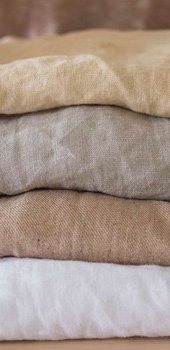
[IMAGE_PLACEHOLDER english prompt: A flat lay photograph of undyed and naturally dyed linen fabric swatches on a light wood surface, showing visible weave texture, a small sprig of dried flax, and a fabric specification card, soft daylight, warm neutral tones, editorial style for a B2B sourcing article]
Because linen is a natural fibre, it is comparatively easy to keep the chemistry simple. Our factory works to AQL 2.5 inspection and holds ISO 9001, OEKO-TEX Standard 100 and SEDEX certification, and we can provide restricted substances documentation for the fabrics we supply. Buyers who plan to make any chemical claim should treat the test report as a sourcing requirement, the same way they treat a fabric specification. The related certificate set is explained in our guide to linen manufacturer certifications.
Extended Producer Responsibility for Textiles
Extended Producer Responsibility makes the company that places a product on the market responsible for its end-of-life handling. For textiles this means registration, reporting of volumes placed on the market, and payment of a fee that funds collection, sorting and recycling. Some EU member states already operate textile EPR schemes, and an EU-wide requirement for member states to establish such schemes is part of the direction of travel in waste legislation.
For a linen brand the mechanics are administrative but the cost is real, and it scales with volume. Just as important, the data you must report is the same data you already collect for sourcing: fibre composition, weight, number of units and, increasingly, information that supports recyclability. Brands that keep clean product data can report in hours instead of weeks.
| Market | EPR status | What the brand does | Data needed |
|---|---|---|---|
| France | Textile scheme in operation | Register and pay per item | Units, fibre mix, weight |
| Netherlands | Producer responsibility in place | Register and report volumes | Units, composition, weight |
| Spain and others | Expanding textile schemes | Register with national scheme | Units and material data |
| EU-wide direction | Member state schemes expected | Prepare harmonised reporting | Structured product data |
The fee itself is rarely the largest cost. The larger cost is disorganisation: products sold in several countries with incomplete weight data, or repeat stock that was never registered. Build the reporting habit from your first order, and EPR becomes a line item rather than a problem. Our seasonal planning guide, linen clothing lead times and schedules, is a useful place to align production volumes with the reporting periods your scheme uses.
ESPR, Ecodesign and the Digital Product Passport
The Ecodesign for Sustainable Products Regulation (ESPR) is the framework that will eventually require textiles sold in the EU to meet ecodesign requirements and to carry a Digital Product Passport. The passport is a structured, machine-readable record of a product, covering material composition, care, repairability and end-of-life guidance, accessed through a data carrier. Textiles are among the first product groups in scope, which is why linen brands should start preparing data now rather than when the delegated act lands.
The good news is that linen is inherently well suited to the passport. Natural fibre composition, a simple care profile and a short supply chain are easier to describe than a blended synthetic product. The work is organisational: deciding who owns the data, in what format, and how it flows from the factory to your product records. Our forward-looking article on tech packs for linen clothing already describes the technical file a factory keeps for each style, which is the natural source for passport data.
If you want to go deeper on the passport itself, the dedicated discussion of data fields and supplier preparation is covered separately in our write-up on digital product passports for apparel, and it pairs well with the traceability model described earlier in this article.
Labelling, Fibre Composition and Traceability
EU textile labelling rules require clear fibre composition and, where relevant, care information on products placed on the market. These rules sit alongside the import documentation covered in our EU importing guide and the practical printing advice in our article on care labels and branding for linen garments. What is changing is the emphasis on accuracy and traceability rather than on the presence of a label.
A common failure is drift between the composition declared on the label and the composition actually shipped. This happens when a factory substitutes a lining, changes a blend slightly, or moves a style to a different fabric without updating the specification. The control that prevents it is the approved sample and the sealed specification, checked against the bulk goods before shipment. Our explanation of AQL sampling and quality inspection shows where that check belongs in the production flow, and it is the same check that protects you from a labelling dispute.
For brands using certified fibre, traceability must also connect the certificate to the shipped goods. A scope certificate proves that a supply chain is certified; a transaction certificate proves that a specific shipment contains certified material. Keep both, reference the shipment on the purchase order, and store them with the invoice so the chain is unbroken from fibre to port.
The Compliance Evidence File Your Factory Should Provide
Across all five frameworks, the same documents reappear. Rather than building a file per regulation, build one evidence folder per style and let each framework draw from it. This is faster, cheaper and far easier to audit. The table below is the working checklist we recommend, and it is the list we can supply for Linenwind orders.
| Document | Supports | Typical source | Keep for |
|---|---|---|---|
| Fabric specification sheet | Composition and weight claims | Fabric mill | Life of the style |
| Restricted substances declaration | PFAS and chemical claims | Dye house or mill | Life of the style |
| OEKO-TEX or equivalent test report | Safety and certification claims | Testing body | Life of the style |
| Scope and transaction certificate | Organic or recycled claims | Certification body | Life of the style |
| Social audit report | CSDDD due diligence | Audit firm | At least one cycle |
| Fibre origin declaration | Traceability and origin claims | Spinner or mill | Life of the style |
| Approved sample and sealed spec | Labelling accuracy | Factory | Life of the style |
Two practical notes. First, ask for documents in a stable format at the start of the season, not in the week a retailer audits you. Second, confirm that certificate numbers and dates are current, because an expired certificate is treated as no certificate at all. Our explanation of how to verify a linen manufacturer certification shows how to check a certificate against the issuing body, and the same habit protects your green claims file.
The document set also has a direct commercial benefit. When your factory can hand you this folder, your MOQ planning, sampling calendar and repeat orders run on solid ground. Our guide to MOQ tiers in custom linen manufacturing explains how volume commitments and fabric selection interact, and our piece on the linen and hemp blend shows how a fibre choice can support a claim you can actually document.
A 2026 to 2028 Action Timeline for Linen Brands
Compliance work is easiest when it is sequenced. The list below turns the five frameworks into a dated plan that a small brand can execute without a legal department.
- Now: create one style-level evidence folder and start collecting the documents in the table above
- Now: rewrite vague environmental claims on product pages and hangtags into specific, document-backed statements
- This season: request a restricted substances declaration and chemical inventory for every fabric in the range
- This season: map your supply chain to tier 2 and tier 3, and record the mill and spinner behind each fabric
- Next season: register for textile EPR in the EU markets where you place goods on the market
- Next season: begin reporting volumes, composition and weight in a consistent product data format
- Ongoing: align sampling and bulk schedules with the reporting periods your schemes use
- Ongoing: keep certifications current and re-verify them before each shipment
- Ahead of the passport rollout: identify the data owner for product passport information and test the flow from factory to product record
- Ahead of due diligence requests: prepare a short due diligence summary your retail customers can reuse
- Ahead of audits: run an internal check of labels, composition and certificates against shipped goods
If this timeline feels heavy, start with the evidence folder. Almost every obligation above is satisfied by information a well-organised factory already produces for quality control. The regulatory layer rewards disciplined sourcing, and disciplined sourcing is something a brand controls directly, whatever the size of its team.
Which EU regulation affects linen clothing brands the most right now?
For most brands the Green Claims Directive is the most immediate, because it affects marketing that is already published. Any environmental claim must be substantiated, so the fastest practical step is to audit every claim on your site, hangtags and listings and match each one to a document.
Does the EU Green Claims Directive apply to small linen brands?
The directive targets claims made to consumers in the EU, so a small brand selling into the EU is affected when it makes an environmental claim. The practical burden is the same as for a large brand: if you claim it, you must be able to prove it.
What does CSDDD mean for a brand that buys linen from China?
It means you need to know and manage the human rights and environmental risks in your value chain, tier by tier. In practice you will be asked for factory details, audit reports, wage and hours evidence, chemical management records and a grievance mechanism.
Is linen affected by the PFAS restriction?
Plain linen does not need PFAS chemistry, so the risk is low compared with performance synthetics. The exposure comes from added finishes such as stain-repellent or easy-care treatments, so ask your mill whether any fluorinated finish is used and keep the declaration on file.
Do I need to register for textile EPR in the EU?
If you place textile products on the market in an EU country that operates a producer responsibility scheme, you generally need to register and report volumes. Requirements differ by member state, so confirm the current rules for each country where you sell.
What is a Digital Product Passport and when does it apply to linen?
It is a structured digital record of a product covering materials, care and end-of-life, accessed through a data carrier. Textiles are among the first product groups under the Ecodesign regulation, so preparing structured product data now is the safe approach.
How do I prove an organic linen claim to a European buyer?
You need a valid scope certificate for the supply chain and a transaction certificate for the specific shipment, from a recognised certification body. Keep both with the purchase order and the invoice so the chain from fibre to shipment is unbroken.
Can my Chinese linen factory help me meet these EU requirements?
Yes, if it works to defined standards and keeps records. Linenwind operates to ISO 9001, OEKO-TEX Standard 100 and SEDEX certification, inspects to AQL 2.5, and can provide fabric specifications, restricted substances documentation and approved samples for your compliance file.
EU compliance is not a single project, it is a way of buying. Build one evidence folder per style, keep certifications current, and turn every claim into a documented fact. If you are planning a linen programme for the EU market, our team can supply the fabric specifications, certification documents and approved samples your compliance file needs. Start with a conversation through our contact page, compare the EU and US routes in our US importing guide, review the general customs picture in our guide to importing linen clothing from China, and see how sustainability standards are applied in production in our sustainable linen manufacturing guide.