

Sustainable Linen Clothing Manufacturing Guide
Sustainable Linen Clothing Manufacturing Guide
Linen is one of the most sustainable natural fibers available to clothing brands, and the reason is structural rather than symbolic. The flax plant grows in temperate climates with rainfall, needs far less water than cotton, produces a fiber that is 100% biodegradable, and leaves almost no part of the plant unused. When a fashion brand asks "is linen sustainable?", the honest answer is that the fiber itself scores strongly on water use, land use, biodegradability, and longevity — but the final sustainability of a linen garment also depends on how it is manufactured, dyed, finished, and shipped. This guide explains both sides so you can make sourcing decisions you can defend to your customers.
If you are a fashion brand, boutique label, or retailer evaluating sustainable fabric options, this guide covers the fiber-level facts about flax, the specific manufacturing practices that keep linen production low-impact, the questions you should ask a factory before ordering, and the practical trade-offs between organic, rain-fed, and blended linen. We also share how we operate at Linenwind, a linen clothing manufacturer based in Dongguan, Guangdong, China, with more than 20 years of experience making linen apparel for brands in Europe and North America.
Why Linen Is Considered a Sustainable Fabric
To judge whether linen is sustainable, you have to look at the full life cycle: how the raw material is grown, how the fiber is extracted and spun, how the fabric is dyed and finished, how long the finished garment lasts, and what happens when it is discarded. Linen performs well at almost every stage, with a few qualifications that matter for sourcing decisions.
Water Use in Flax Cultivation
Flax is a rain-fed crop. In the main European growing regions — northern France, Belgium, the Netherlands, and the Baltic states — flax is typically grown without irrigation, relying on natural rainfall. Cotton, by comparison, is grown in drier regions and requires substantial irrigation in most producing countries. This difference is the single most cited reason why linen is considered more sustainable than cotton on water consumption. The exact ratio depends on the region and the farming method, but the direction of the comparison is consistent: flax uses a fraction of the water that cotton requires.
Low-Input Farming and Land Use
Flax grows well in poor soil, which means it does not compete with high-value food crops for the best farmland. It also requires relatively low levels of fertilizer and pesticide compared with conventional cotton. The entire plant is useful: the stem produces the fiber for textiles, and the seeds are used for linseed oil, food products, and animal feed. When the fiber is used for clothing, the seed harvest remains a commercial product in its own right, which improves the overall resource efficiency of the crop.
Biodegradability and End of Life
Linen is a plant-based cellulosic fiber, and 100% linen fabric is biodegradable under normal composting conditions. Unlike synthetic fibers such as polyester, nylon, or acrylic, linen does not shed persistent microplastics when washed. In landfill or industrial composting environments, linen breaks down over a relatively short period. This gives 100% linen a clear end-of-life advantage over synthetics and even over some other natural fibers that are commonly blended with synthetics to reduce cost.
The short answer: is linen sustainable? At fiber level, yes — flax is rain-fed, low-input, fully plant-based, biodegradable, and highly durable. The sustainability of the finished garment then depends on processing choices, which are within your control as the brand.
The Sustainable Linen Manufacturing Process Step by Step
Between the flax field and the finished garment there are several processing stages. Each one has a lower-impact and a higher-impact version, and a responsible manufacturer should be able to explain which version they use.
- Retting: After harvest, flax stems are left in the field for dew retting — a natural process in which moisture and microorganisms break down the pectin that binds the fiber to the stem. Dew retting uses no chemicals and no energy input beyond the weather, which is why it is the dominant method in Europe.
- Scutching and hackling: The retted stems are mechanically processed to separate the long fiber bundles from the woody shives. These steps are mechanical; the shives and dust are collected and can be used in building materials, paper, or animal bedding, so the process generates very little waste.
- Spinning: Long flax fibers are wet-spun for fine, smooth yarns, while shorter fibers are dry-spun for more textured yarns. Both methods are mechanical. Energy use here depends on the mill, so asking about the mill's energy mix is a legitimate sourcing question.
- Weaving or knitting: The yarn becomes fabric. At this stage the fabric's weight (gsm), weave structure, and hand feel are decided against your specification.
- Dyeing and finishing: This is the stage with the largest environmental variables — water use, dye chemistry, and finishing chemicals. Garment-dyeing, low-liquor-ratio dyeing, and OEKO-TEX-certified dyes all reduce impact compared with conventional batch dyeing.
- Cutting and sewing: The fabric is cut into garment panels and sewn. Fabric utilization (marker efficiency) determines how much fabric waste is generated; modern spreading and cutting with optimized markers can hold waste to a low single-digit percentage.
Linen vs Cotton vs Polyester: A Sustainability Comparison
The most useful way to understand linen's environmental profile is to compare it with the two fibers it is most often measured against. The table below summarizes the fiber-level differences that matter to a brand making sustainability claims.
| Factor | Linen (flax) | Cotton | Polyester |
|---|---|---|---|
| Origin | Plant fiber, rain-fed in temperate regions | Plant fiber, often irrigated | Petroleum-based synthetic |
| Water demand | Low — relies mainly on rainfall | High in most producing regions | Process water only; high energy to produce |
| Biodegradability | 100% biodegradable | Biodegradable | Not biodegradable; sheds microplastics |
| Durability | Very high; strengthens when wet | Moderate | High, but degrades with UV and heat |
| End of life | Composts naturally | Composts slowly | Landfill or energy-intensive recycling |
| Comfort | Breathable, moisture-wicking, cool | Soft, absorbent | Less breathable, can trap heat |
This is a fiber-level comparison, not a complete life-cycle assessment. A linen garment that is dyed with heavy-metal dyes and air-freighted is less sustainable than an undyed organic cotton garment made locally. But when comparable processing is assumed, linen is consistently ranked among the most sustainable clothing fibers — which is why the question "is linen sustainable?" is usually answered yes by independent textile sustainability resources.
What Makes Linen Manufacturing Sustainable in Practice
Fiber choice is only half of the story. The manufacturing practices at the factory determine most of the environmental footprint of the finished garment. Here are the practices that actually matter, and the questions you should ask a supplier about each one.
Dyeing and Water Treatment
Textile dyeing is water-intensive and, when unregulated, a source of water pollution. A sustainable linen manufacturer should be able to document its wastewater treatment process and dye chemistry. Ask whether the factory uses certified dyes (for example OEKO-TEX Standard 100 certified inputs), whether wastewater is treated before discharge, and whether the dyehouse operates with controlled liquor ratios. These three answers tell you more about environmental practice than any marketing page.
Fabric Utilization and Waste Control
Cutting generates fabric waste. A well-run factory plans markers to maximize fabric utilization and reuses cutting scraps where possible. When we plan production at Linenwind, marker efficiency is reviewed before cutting starts, and fabric remnants are collected and reused for sampling or small-batch accessories rather than discarded. Asking a factory about its marker efficiency and scrap handling gives you a concrete signal of its production discipline.
Certifications You Can Verify
Certifications are the easiest way to verify sustainability claims without visiting the factory. Relevant certifications for linen include OEKO-TEX Standard 100 (tested for harmful substances), GOTS (organic processing standard), and, for flax specifically, European Flax certification, which covers traceability and cultivation practices for European-grown flax. When a supplier names a certification, ask for the certificate number and check it against the issuing body — this is standard due diligence for a brand making sustainability claims to its own customers.
Sourcing tip: never accept "eco-friendly" as a statement. Ask for the mechanism: which certification, which certificate number, which water treatment process, which dye chemistry. If a supplier cannot name a verifiable practice, treat the claim as unverified.
How to Choose Sustainable Linen for Your Collection
Sustainability is a specification, not a mood. When you brief a manufacturer, the following choices have a direct environmental impact.
100% Linen vs Blends
100% linen is the most defensible sustainability story because it is fully biodegradable and plastic-free. Linen blends with cotton remain plant-based and biodegradable, while blends with rayon or polyester change the end-of-life profile — linen-rayon blends, for example, are comfortable and wrinkle-resistant but lose the pure-fiber biodegradability story. Decide first what your sustainability claim actually is, then choose the fiber composition that matches it.
Undyed and Natural-Tone Linen
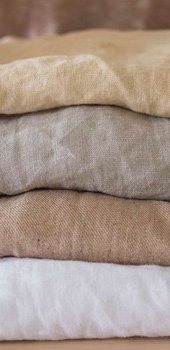
Skipping dyeing altogether is the lowest-impact option. Natural linen shades — the ecru, oatmeal, and sand tones of undyed or minimally processed flax — require no dye chemistry at all. Many brands build a capsule around undyed linen and use garment-dyeing only for colors that must be exact.
Fabric Weight and Garment Longevity
A heavier, well-constructed linen garment lasts longer, and longevity is the most underrated sustainability metric: a shirt worn 100 times has a much lower impact per wear than a shirt worn 10 times. For breathable summer wear, 100–180 gsm linen is the common range; for workwear and jackets, 180–260 gsm gives more structure and durability. Specify the weight and construction that match the garment's intended lifespan rather than the cheapest option.
Practical Sourcing Checklist for Sustainable Linen
When you evaluate a linen clothing manufacturer, use this checklist. Every item maps to a verifiable fact, not a promise.
- Fiber origin: Where is the flax grown, and can the supplier name the region or provide a certificate of origin?
- Fiber composition: What is the exact composition (for example 100% linen, or 55% linen / 45% rayon) and is it stated on the fabric test report?
- Certifications: Which certificates does the factory hold, and can you see the certificate numbers?
- Dyeing: What dye system is used, and is wastewater treated before discharge?
- Sampling: What is the sample lead time, and how many rounds of samples are included before bulk?
- MOQ: What is the minimum order quantity per style and per color?
- Quality control: What inspection points exist between cutting and packing, and is there a pre-shipment inspection report?
- Waste handling: What happens to cutting scraps and rejected fabric?
What Linenwind Does in Sustainable Linen Manufacturing
We are a linen clothing manufacturer based in Dongguan, Guangdong, China, with more than 20 years of experience. Our production covers the full cycle from fabric selection and pattern development to sampling, bulk production, and quality inspection, which means the sustainability-related decisions above are made in one place rather than scattered across separate suppliers.
Our standard order terms are practical for brands of any size: a minimum order quantity of 60 pieces per style, sample development within 7–14 days, and bulk production within 25–35 days after sample approval. These are the actual working figures we quote to clients — you can verify them in our contact page and use them to plan your collection calendar. We recommend you request a pre-production sample and a bulk fabric test report before mass production, and we prepare both as part of the standard process.
Because we manufacture in our own facility, we can control the parts of production that determine environmental impact: marker planning to reduce cutting waste, careful fabric purchasing to avoid over-ordering, dyehouse coordination for controlled dyeing, and inspection at every stage from fabric inwards to finished garment. None of this replaces third-party certification — if your sustainability claim requires it, ask us for the relevant certificates and we will share what we hold.
How Sustainable Linen Claims Are Verified
When your brand decides to communicate sustainability, the claim must survive scrutiny from customers, retailers, and increasingly from marketplaces. Three verification layers are common in the European and North American markets where our clients sell. First, fiber-level traceability: certificates such as European Flax or organic certifications connect the linen back to a defined cultivation region and standard. Second, processing-level verification: OEKO-TEX Standard 100 confirms that the finished fabric or garment has been tested for a defined list of harmful substances, which covers the dyeing and finishing stages that fiber-level claims do not. Third, your own documentation: the tech pack, test reports, and factory audit records that you keep on file and can share with a retailer when asked.
It is worth understanding the difference between these layers because they answer different questions. A European Flax certificate answers "where was the fiber grown and under what practices?". An OEKO-TEX certificate answers "has this product been tested for harmful substances?". Neither certificate alone answers "is this garment sustainable?" — that judgement combines fiber choice, processing, transport, and use. A brand that can name all three layers, and honestly state which ones it has documented, is in a much stronger position than a brand that simply labels a garment "eco".
For B2B buyers, the practical implication is simple: ask your manufacturer which of these layers they can document today, and build the missing pieces into your sampling plan. Certificates take time to issue, so the conversation should happen at the development stage, not after the collection has shipped. Our standard sampling process at Linenwind includes fabric test reports as part of the pre-production sample package, so the documentation habit starts early rather than being bolted on at the end.
Limitations and Honest Trade-Offs
For a balanced sourcing decision, it is worth naming the limitations of linen as well as its strengths. Linen wrinkles easily, which some customers read as a quality problem rather than a natural characteristic of the fiber. Linen can be more expensive than cotton or polyester at equivalent quality, because flax cultivation and long-fiber processing are more labor-intensive. And a garment's total footprint includes shipping — a linen shirt made in China and shipped to Europe has a freight footprint that must be acknowledged, even though it is far smaller than the footprint of a synthetic garment over the same route.
None of these limitations makes linen unsustainable. They make it a fiber that rewards honest communication: if your brand explains why linen wrinkles and how to care for it, customers accept the trade-off; if your brand silently claims "eco-friendly" without specifics, customers eventually ask the questions you should have answered first.
Frequently Asked Questions About Sustainable Linen
Is linen more sustainable than cotton?
At fiber level, usually yes: flax is rain-fed in most regions, needs less water than irrigated cotton, requires fewer inputs, and is fully biodegradable. The comparison becomes nuanced when processing, dyeing, and shipping are included, which is why a full answer depends on the specific supply chain.
Is linen biodegradable?
Yes. Linen is a plant-based cellulosic fiber and 100% linen fabric biodegrades naturally. It also does not shed microplastics when washed, which is a key difference from polyester and other synthetic fibers.
What is the most sustainable way to dye linen?
The lowest-impact option is no dyeing at all — natural ecru and oatmeal tones. When color is required, garment-dyeing with certified low-impact dyes, or dyeing with controlled liquor ratios and treated wastewater, reduces the footprint compared with conventional batch dyeing.
Does sustainable linen cost more?
Certified, traceable linen generally costs more than conventional cotton or synthetic blends, mainly because flax processing is more labor-intensive and certified supply chains are smaller. The cost difference is typically justified by durability — a well-made linen garment lasts longer, which lowers cost per wear.
How can I verify a factory's sustainability claims?
Ask for certificate numbers and check them with the issuing body, request a fabric test report confirming fiber composition, ask about wastewater treatment and dye chemistry, and request photos or records of the production process. Verifiable documentation is the only reliable evidence.
What is the MOQ for custom sustainable linen clothing?
At Linenwind, the standard MOQ is 60 pieces per style, with sample development in 7–14 days and bulk production in 25–35 days after approval. This keeps custom linen accessible to smaller brands while maintaining production efficiency.
Related reading: for a quick fiber-level answer, see our FAQ Is Linen an Eco-Friendly Fabric? and the supplier-focused Are linen clothing manufacturers environmentally friendly?. For a deeper dive, read Why Linen Is the Most Sustainable Fabric and How Linen Shirts Fit Sustainable Fashion Collections.
Closing Summary
Is linen sustainable? The fiber-level answer is a clear yes: flax is rain-fed, low-input, fully biodegradable, and exceptionally durable. The garment-level answer depends on choices you control — fiber composition, dyeing, finishing, quality, and how long the garment is worn. By specifying 100% linen or plant-based blends, requesting verifiable certifications, and working with a manufacturer that can document its process, you can build a linen collection with a sustainability story that holds up to customer questions.
If you are planning a linen collection and want to work with a manufacturer that manufactures in-house with documented processes, start with our linen clothing products, read more in our blog, or send us an inquiry with your target fabric, style, and quantities. We will respond with a concrete proposal including sampling timeline and MOQ.