Casual Chic Linenwear Custom Manufacturing
What Sustainable Linen Options Are Available?
Fabric Sourcing Answer
What sustainable linen options are available?
Four options are commercially available to apparel brands: GOTS-certified organic linen, GRS- or RCS-certified recycled linen and recycled cotton blends, traceable European Flax®, and conventional linen built for longevity and tested to OEKO-TEX Standard 100. They differ in what is certified, what the certificate proves, what the premium is, and how quickly the fabric can be supplied. Organic proves fibre origin and processing. Recycled proves material content. European Flax® proves growing origin and chain of custody. Conventional linen proves product safety and factory systems, not fibre ethics.
The Four Options in Plain Terms
Organic linen (GOTS)
Certified organic fibre plus a processing standard covering chemical inputs, wastewater and social criteria across spinning, weaving, dyeing and sewing. The strongest fibre-ethics claim available, and the most expensive to run at small volume.
Claim it supports: organic
Recycled linen or cotton blend
Mechanically recycled fibre blended with virgin linen or cotton to restore strength. GRS verifies at least 20% recycled content with chain of custody and social criteria; RCS verifies content from 5% with no wider social requirement.
Claim it supports: recycled content
Traceable European Flax®
Fibre grown in Western Europe with documented chain of custody from field to fabric. Rain-fed and low-input in normal practice, but not an organic certification and should never be described as one.
Claim it supports: origin and traceability
Conventional linen, longevity-led
Standard European or Chinese flax, tested to OEKO-TEX Standard 100 for harmful substances and produced under ISO 9001 and SEDEX-audited systems. The lowest-cost route and the easiest to scale into repeat programmes.
Claim it supports: safety and durability
Most brands do not choose one of these. They run a mix, because the claims serve different purposes: organic carries a premium hero story, recycled carries a circularity story, traceable European Flax® carries an origin story at close to conventional cost, and conventional linen carries volume. The full fibre-level background on organic certification sits in our guide to what organic linen is and how it is certified; the comparison below is about choosing between routes.
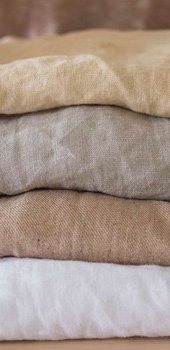
[IMAGE_PLACEHOLDER: 浅色木桌上平铺四块未染色亚麻面料小样,分别为本白有机亚麻、燕麦色欧麻、略带竹节感的再生亚麻混纺、灰色再生棉混纺,旁边放置规格卡与卷尺,自然侧光,暖色调]Side-by-Side Comparison
Option comparison for apparel sourcing
| Option | Certificate | What it proves | Cost direction | Availability | Best for |
|---|---|---|---|---|---|
| Organic linen | GOTS | Organic fibre, restricted chemistry, wastewater, social criteria | Highest | Narrower in specific yarn counts, mill minimum applies | Hero styles, published fibre story, GOTS-expecting markets |
| Recycled linen blend | GRS | At least 20% recycled content, chain of custody, environmental and social criteria | Moderate | Growing, strongest in 140-220 gsm casual weights | Casual shirts, overshirts, trousers, loungewear |
| Recycled cotton blend | GRS or RCS | Recycled content; RCS stops at content only | Low to moderate | Widest among recycled routes | Entry price points, jersey-look pieces, gift sets |
| European Flax® | Origin and traceability scheme | Western European origin plus chain of custody | Low to moderate | Broad, close to conventional linen | Volume programmes, origin-led storytelling |
| Conventional linen | OEKO-TEX Standard 100 | Product safety limits on the finished article | Lowest | Broadest, 50+ stock qualities | Repeat basics, workwear, hospitality, private label |
Cost direction is relative, not a fixed percentage. Certified fibre premiums move with crop, spinner capacity and order volume, and are quoted per quality and quantity.
Two clarifications prevent most specification errors. First, OEKO-TEX Standard 100 is a product safety test, not a fibre-origin claim: a fabric can pass every substance limit and still be conventional flax. Second, GOTS and OEKO-TEX are not alternatives; a GOTS fabric is certified for fibre and processing, while trims, prints and interlinings still need their own safety evidence. Our overview of linen manufacturer certifications explains how the documents stack at factory level.
The Documents Behind Each Option
Buyers often ask for “the certificate” as if a single PDF settled the question. A complete evidence set for one certified order normally contains four different documents, and each one answers a different question. Understanding the division of labour prevents the situation where a brand holds an impressive-looking certificate that still cannot support the wording on the hangtag.
- Scope certificate. Issued to a facility, listing the product categories and processes it is allowed to handle, with a validity period. It proves capability, not your shipment. A scope certificate for garments does not automatically cover fabric trading, and a scope certificate for one product category does not cover another.
- Transaction certificate. Issued per shipment or per invoice, stating the certified weight, the composition and the reference back to the scope certificate. This is the document a marketplace compliance team or a customs reviewer will ask for, and it is the one most often missing when a brand tries to substantiate a claim after the goods have arrived.
- Test report. For OEKO-TEX Standard 100, a report against the limit values for the relevant product class, covering the shell fabric and, where included in the application, trims, threads and prints. The certificate number is usually valid for one year, after which the testing has to be renewed.
- Audit or facility report. ISO 9001, SEDEX or an equivalent social audit, covering management systems and labour practices at the site rather than the product itself. Useful for supplier approval, not for a consumer-facing fibre claim.
File the four together, per shipment, with the order number on each. The practical test is simple: if someone asked you next season to prove the claim on a garment you shipped last year, could you produce the transaction certificate for that weight, in that composition, within an hour? Brands that can answer yes have a documentation habit; brands that cannot usually have a claims problem waiting to surface.
What Availability Looks Like in Practice
Availability is the constraint that turns a sensible sourcing plan into a late delivery. Certification is a paper process; fibre supply is a physical one, and the two do not always move at the same speed. The pattern below is what buyers typically encounter when they start sampling rather than planning.
- Organic linen. Available, but narrower in specific yarn counts and widths, with mill minimums per certified quality. A colour that exists in conventional linen may need a dedicated dye lot in organic, which adds lead time and cost.
- Recycled linen blends. Strongest in the middle of the weight range, roughly 140-220 gsm, where casual shirts, overshirts and trousers sit. Very light weights lose strength faster, and very heavy weights are harder to source consistently.
- Recycled cotton blends. The widest availability among recycled routes, which is why they appear so often at entry price points. Check whether the recycled share is pre-consumer or post-consumer, because the two carry different stories and different documentation.
- European Flax® and conventional linen. The broadest supply, supported by stock qualities across the 100-260 gsm band, which allows development without a custom weave minimum.
The practical conclusion is to reserve certified qualities for the styles that carry the claim, and to build the rest of the range on stock linen that can be replenished quickly. That is not a compromise on quality; it is how a collection stays deliverable when one certified quality slips.
How to Choose: Five Steps
1
Write the claim before the fabric brief
Decide the sentence that will appear on the hangtag and the product page. “Made with 95% organic linen” requires GOTS. “Made with 30% recycled linen” requires GRS or RCS at that percentage. “European flax” requires origin documentation. Working backwards from the claim eliminates the most common mismatch.
2
Check the certificate scope, not just its logo
Ask for the scope certificate and confirm the product category, the processes covered and the validity date. A scope certificate authorises a facility; it does not certify your order. The shipment-level document is the transaction certificate, and it should match your order weight and composition.
3
Match the route to the weight and the garment
Linen for shirting and dresses usually sits between 100 and 200 gsm; outerwear and trousers run heavier, up to 260 gsm. Recycled blends perform best in the middle of that range. Organic availability is narrower at the extremes, and very light weights in recycled linen can lose more strength than the garment can tolerate.
4
Price the premium through fabric, not through the garment
Fabric is typically 30-45% of FOB and labour 25-35%, so a fibre premium enters through the fabric line multiplied by consumption. If a certified quality costs a few dollars more per metre and the style uses two metres, the garment cost moves by roughly twice that difference, plus any mill minimum penalty on small runs.
5
Validate on a made-up sample, not on a swatch
Shrinkage of 3-7% on first wash, seam strength at stress points, and colour consistency across dye lots only show up on a finished garment. Approve a sample in the actual quality, wash it the way the care label will instruct, and measure it before bulk.
Supplier questions that separate real options from brochures
Which certificate covers which product category, and when does it expire?
What exact percentage is certified, and is it stated on the transaction certificate?
Is the recycled content pre-consumer or post-consumer?
Which yarn counts and widths are actually available now, not seasonally?
What is the measured shrinkage after three washes?
Are trims, threads and interlinings inside the same certification scope?
What Each Option Means for Production
MOQ 60 pieces
Per style and colour for garment production. Certified fabric may carry a higher effective minimum because mills run certified qualities in segregated lots.
Sampling 7-12 days
Sampling window is 7-14 days depending on fabric availability. Swatches are free; made-up samples carry a $40-150 fee, refunded against bulk.
Bulk 25-35 days
After sample approval and fabric booking. Certified documentation is requested in parallel so goods and certificates ship together.
First order 35-60 days
End to end including fabric booking, trims, inspection and shipping preparation.
50+ stock qualities
Stock linen across the 100-260 gsm band supports fast development without a custom weave minimum.
AQL 2.5 inspection
Major-defect inspection standard unless the buyer specifies otherwise, with measurements checked against the approved sample.
Recycled routes also open up blend directions that are worth testing for handfeel before committing a whole range. A recycled cotton and linen blend softens the surface and increases drape, which suits casual sets; a linen and hemp blend pushes in the opposite direction, adding dry texture and durability. The trade-offs in linen and hemp blending are a useful reference when positioning a recycled quality against a natural-fibre alternative.
Claims that fail review
- “Organic” on a blend below the 70% threshold, or below 95% without the qualifier “made with organic”.
- Using OEKO-TEX Standard 100 as evidence of fibre origin or organic content. It tests substances, not farming.
- Marketing a garment as recycled when only one component carries recycled content and the percentage is not stated.
- Relying on an expired scope certificate, or on a certificate that does not cover the product category being shipped.
- Describing European Flax® as organic, pesticide-free or certified sustainable farming.
- Publishing a general “sustainable” or “eco-friendly” claim with no specific, substantiated qualifier.
Quick Answers
Is recycled linen as strong as virgin linen? Not at the same weight. Mechanical recycling shortens the staple, so commercial qualities blend 20-50% recycled fibre with virgin linen or cotton. For stress seams, stay towards the lower share or increase fabric weight.
Is European Flax® organic? No. It certifies Western European origin and traceability. Organic requires a separate certification such as GOTS.
Do I need both GOTS and OEKO-TEX? For most large retailers, yes. GOTS covers fibre and processing; OEKO-TEX Standard 100 covers the finished article including trims.
How much does certified linen add to cost? There is no fixed percentage. The premium is the per-metre fibre difference multiplied by consumption, plus segregation and documentation costs spread across the order, which is why small certified capsules cost more per unit than large programmes in the same quality.
Can one collection mix several options? Yes, and most do. A workable structure is a volume tier on traceable European Flax®, a certified capsule in GOTS organic linen for hero styles, and a recycled blend tier for casual pieces. The rule is one claim per tier, stated at the percentage the certificate actually supports, so that no garment carries a claim its documents cannot defend.
Comparing routes for a 2027 range?
Send the tech pack and the claim you need to support. We reply within 48 hours, quote in 3-7 working days, and can send swatches from more than 50 stock qualities while you decide between organic, recycled and traceable European flax.
Linenwind is a linen garment manufacturer in Dongguan, China, working OEM, ODM and private label for brands in Europe and North America. Production figures quoted here reflect current factory standards: MOQ 60 pieces per style and colour, sampling 7-12 days, bulk 25-35 days, first order 35-60 days, AQL 2.5, and factory certification to ISO 9001, OEKO-TEX Standard 100 and SEDEX. Certified organic and recycled qualities are sourced against project requirements; certificate scope and availability are confirmed at quotation.