Casual Chic Linenwear Custom Manufacturing






What Makes a Quality Linen Shirt?
Product FAQs
What Makes a Quality Linen Shirt?
A quality linen shirt is decided by eight checkpoints, and a buyer can inspect every one of them on a sample: the fabric weight and weave, the stitching and seam finish, the collar build, the buttons and how they are attached, the front placket and cuffs, the labels and care content, the graded size and fit, and the pressing and finishing. None of these depends on brand name or price alone. A shirt in a 180 GSM linen with a lightly fused collar, even button spacing, French side seams and a care label that matches its actual wash behaviour will outperform a heavier, more expensive shirt that skips any one of those checks. The sections below explain what to look at, the realistic production ranges we work to, and where a linen shirt usually fails a quality review.
The Eight Quality Checkpoints at a Glance
Quality in a linen shirt is measurable rather than a matter of opinion, which is why we reduce it to eight checkpoints. Each one can be reviewed on a physical sample before a bulk order is released, and each one has a failure mode that appears after washing if it was skipped. The table below is the short version a buyer can carry into a sample review, and the sections that follow take each foundation in turn.
| # | Checkpoint | What to look for | Typical failure if missed |
|---|---|---|---|
| 1 | Fabric | Weight in GSM matched to the season, a clean even weave, consistent dyeing, no heavy slub running into a seam | Transparency, or a shirt that feels either flimsy or stiff |
| 2 | Stitching and seams | Even stitch density, no skipped stitches, a stated seam finish for each seam | Frayed or split seams after the first wash |
| 3 | Collar | Symmetric points, a clean roll, interfacing weight matched to the fabric | Collapse, fused shine or puckering after pressing |
| 4 | Buttons | Matched size and colour, an even cross-stitch attach, no loose threads | Buttons that fall off within the first month |
| 5 | Placket and cuffs | A straight placket, locked button spacing, an even cuff depth on both sleeves | Gaping at the chest and a wavy front edge |
| 6 | Labels and care content | Main label, size label and a care label whose wording matches the fabric's real behaviour | Customer returns after an incorrect wash |
| 7 | Size and grading | A graded range on the agreed block, with measurements inside the tolerance table | Inconsistent sizing across the range |
| 8 | Pressing and finishing | A clean inside, trimmed threads, folded and packed to the brand's instruction | A garment that looks used on arrival |
Every checkpoint can be verified on a sample; none of them requires a laboratory to judge.
Two of these checkpoints, fabric and stitching, are foundational because they decide whether the other six have a stable base. The remaining six are specification decisions a brand can write into a tech pack and a factory can repeat order after order. A worked example of how collar, cuff and seam choices are built into a shirt programme is set out in the linen shirt manufacturing construction guide.
Fabric and Stitching: The Two Foundations
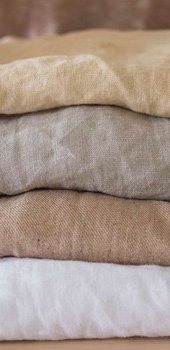
Fabric quality in a linen shirt is not about a single number; it is about whether the weight, weave and finishing suit the garment's job. We hold more than 50 stock linen specifications between 100 and 260 GSM. High summer and resort shirts usually sit between 120 and 180 GSM, while office and transitional shirts often work better between 180 and 220 GSM. A shirt that is too light for its intended season shows the wearer's outline and every inside seam; a shirt that is too heavy holds a crisp collar but loses the soft drape that makes linen comfortable. Matching weight to season by hand-feel against a reference garment is more reliable than choosing by number alone, and the checks we apply on incoming fabric are covered in the related question on how linen manufacturers ensure fabric quality.
Stitching is the second foundation, and on linen it is the checkpoint most often underestimated. Linen has almost no natural recovery, so a seam that would survive on a stretch fabric can fray or split on linen once the customer washes it. That is why the seam finish must be stated per seam rather than per garment: a plain pressed seam under a top-stitch hides raw edges but still shows inside, an overlock finish wraps the edge and prevents fraying, and a French seam encloses the raw edges entirely so the inside reads as a finished garment. The stitch density must also suit the fabric, because a stitch that is too tight perforates a loose linen weave while a stitch that is too loose leaves the seam weak.
- Weave and slub. A clean, consistent weave with moderate slub is normal in linen; heavy slub running along a seam line weakens it.
- Stitch density. Set to suit the fabric weight so the needle does not perforate the weave.
- Seam finish per seam. Side, sleeve and yoke seams can each need a different finish.
- Shrinkage allowance. A wash test on the production lot fixes the allowance before cutting; linen typically moves 3 to 7 percent on first wash, and the related question on how much linen shrinks explains the drivers.
- Thread and tension. A matched thread and a balanced tension keep the stitch clean on both faces of the shirt.
If a brand can only verify one thing on a sample, the honest test is to turn the shirt inside out. The inside shows the seam finish, the thread ends, the placket construction and the hem, and none of those can be hidden by careful pressing on the outside. A shirt whose inside is clean is usually a shirt whose outside will hold up.
Collar, Cuffs and Placket: The Construction You Can See
The collar, cuffs and front placket are the three most visible construction elements of a linen shirt, and they are the fastest way to judge whether a factory understands linen. Each is a build choice rather than a fixed standard, and each changes both the labour time and the price. Three collar builds cover most programmes: the Italian or spread collar with a fused stand, the Cuban or camp collar with a one-piece self-faced construction, and the mandarin or stand collar with no fold at all.
Italian or spread collar
A two-piece collar with a separate stand so the fold sits on the stand, not the leaf. Suits office, hospitality and smart casual ranges. The main risk is fused shine when the interfacing is too heavy for a light linen.
Cuban or camp collar
A one-piece collar opened into a wide, flat shape with a facing strip instead of a stand. Suits resort and relaxed styles. The main risk is a curled front edge or a neckline that stretches without stay tape.
Mandarin or stand collar
A single narrow band with no fold and a short placket or button loop. Suits minimal and unisex ranges. The main risk is inconsistent band height and a top edge that warps after washing.
A quality collar is symmetric in its points, rolls cleanly rather than sitting flat, and uses an interfacing weight that supports the shape without stiffening the linen into a board. The cuff follows the same logic: a single-button barrel cuff is standard and least costly, while a two-button adjustable cuff buys half a size of adjustment for the wearer at the price of extra labour. A quality placket is straight, its button spacing is locked in the pattern, and its inner finish is clean enough that a rolled-up sleeve does not expose a raw edge. For brands positioning shirts inside a business casual range, the linen shirt styles, fits and collar guide sets out how these builds sit in a commercial line.
Two checks belong at sample review. First, measure the collar height, point length and cuff depth in millimetres and compare them to the tech pack, because an image reference alone allows drift between the sample and the bulk order. Second, confirm the placket type, since a two-layer folded placket holds buttons better over time than a single-layer strip but consumes more fabric and more minutes, and the two should be quoted as separate cost lines.
Buttons, Labels and Finishing
The small components decide whether a linen shirt still looks like the sample after twenty washes, and they are the easiest to specify and the easiest to leave to chance. Buttons, labels and finishing are as much a part of quality as the fabric, and each is a line a buyer can approve in writing.
- Button material and size. Corozo, mother-of-pearl, polyester or recycled resin each carry a different weight, finish and cost; linen shirts usually take a four-hole 18 to 20 line button.
- Button attach. A cross-stitch with a short stem or a machine-locked attach; the method decides whether the button survives a wash.
- Interfacing. Matched to the fabric weight so collars and cuffs keep their shape without shining or puckering.
- Labels. A woven main label, a size label and a care label, all consistent with the branding on the packaging.
- Care content. Wording that matches the fabric's measured wash behaviour, not a generic template.
- Thread ends and finishing. Trimmed inside, seams pressed, and no loose threads at the placket, cuff or hem.
A useful discipline is to ask for a trim card in the sample comments: one physical card showing the interfacing, button, thread and labels as they will be used. A trim card removes a whole class of rework, because the bulk order is then matched against a reference rather than a written description. Checking the components before the order is released is far cheaper than discovering them at final inspection, when the fix is a remake.
Size, Fit and Wash Behaviour
A shirt can pass every construction checkpoint and still disappoint if its size range and wash behaviour are wrong. Linen has almost no stretch, so grading must be deliberate, and the allowance for first-wash shrinkage must be decided before the marker is cut. The steps below are the sequence we follow to make a shirt land on its labelled size after the customer's first wash.
- Approve one base size on a fit model, then grade the range around that approved base rather than a sketch.
- Record the yoke, shoulder, sleeve and body length increments separately so the shirt keeps its fit convention across the range.
- Wash a sample of the production fabric lot and measure the change in length and width as a percentage.
- Add the measured allowance at cutting and record it on the cutting ticket, so the specification and the floor agree.
- Re-measure the finished shirt after washing and compare the key points to the graded specification within tolerance.
Two failures recur. The first is approving a sample without a wash test, which pushes a size problem to the customer's first wash. The second is grading from a generic block, which produces a range where one size fits and the others drift. Both are cheap to prevent at sampling and expensive to correct after bulk. In-line checks catch seam and construction faults while the shirt is still on the machine, and final inspection at AQL 2.5 then applies a defined sampling plan to the finished lot, with a measurement check against the graded spec. The quality inspections during linen clothing production answer lists those stages in more detail.
How We Check a Linen Shirt Before It Ships
As a Dongguan B2B linen clothing factory with more than 20 years in OEM and ODM work, we apply the same checkpoint list to every shirt programme, and we quote the commercial terms a brand plans around at the same time as the construction detail.
MOQ 60 pcs per style per colour
Sampling 7 to 12 days
Bulk 25 to 35 days after approval
Final inspection at AQL 2.5
50+ stock linen specs, 100 to 260 GSM
ISO 9001, OEKO-TEX Standard 100, SEDEX
48 hour initial reply
Quotation in 3 to 7 working days
Unit cost is built from four blocks: fabric at 30 to 45 percent depending on weight and width, labour at 25 to 35 percent depending on how many construction options are specified, trims and finishing at 10 to 20 percent, and overhead including sampling at 10 to 20 percent. That is why two shirts in the same fabric can carry very different prices once the collar build, placket type, cuff option and seam finish change. The related question on minimum order quantity for custom linen clothing explains how order size interacts with price, and the best linen shirt manufacturers guide explains how to weigh these points when comparing factories.
Do not judge a linen shirt from the outside alone. A shirt can be pressed to look flawless while its seams are raw, its collar is over-fused and its buttons are loosely attached. Turn it inside out, measure the collar and cuff, and ask for a wash test on the production fabric lot before approving bulk. Those three checks catch most of the faults that otherwise appear in the first month of wear.
Seen this way, the question of what makes a quality linen shirt is less about a single feature and more about whether a factory can hold all eight checkpoints across a sample, a wash test and a bulk run. That is what makes a shirt repeatable, and repeatability is what protects a brand's size chart, its reorder cycle and its customer reviews. A quality shirt is not necessarily the heaviest or the most expensive; it is the one whose specification was decided, written down and verified before the order was placed.
Ready to brief a linen shirt programme? Send your collar direction, target season, size range and fabric direction.
Request a Quotation Shirt Construction GuideFigures describe Linenwind standard practice as a Dongguan B2B linen clothing factory with more than 20 years of OEM and ODM experience: MOQ 60 pieces per style per colour, sampling 7 to 12 days in a 7 to 14 day window, bulk 25 to 35 days, first order 35 to 60 days, sample fee 40 to 150 US dollars fully refundable, free swatches, first-wash shrinkage 3 to 7 percent, stock linen 100 to 260 GSM, AQL 2.5 inspection, ISO 9001, OEKO-TEX Standard 100 and SEDEX. Figures are planning references, not a quotation.
[IMAGE_PLACEHOLDER alt="Flat lay of a quality linen shirt inside out showing clean seam finish, button attach and label detail"] [IMAGE_PLACEHOLDER alt="Sample review bench with a linen shirt, collar measurement gauge, trim card and AQL inspection checklist"]