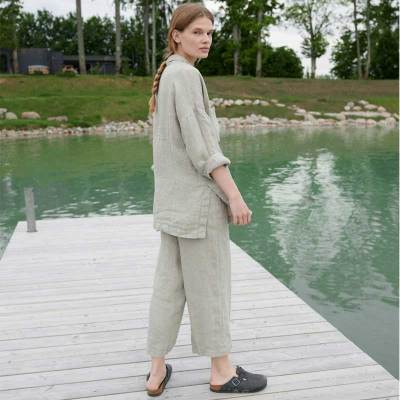
Casual Chic Linenwear Custom Manufacturing
What Should I Ask a Linen Supplier Before Ordering?
What Should I Ask a Linen Supplier Before Ordering?
Before you order from a linen supplier, ask about eight areas: shrinkage control and fabric testing, MOQ per style and color, sampling turnaround and fees, bulk lead time, quality control and AQL, current certifications, pattern and design ownership, and payment and shipping terms. The three questions that filter out unreliable suppliers fastest are: "How do you test and compensate for linen shrinkage?", "What is your MOQ per style and color?", and "Can you send your current ISO 9001, OEKO-TEX, and SEDEX certificates?" At Linenwind, the answers are: pre-wash and shrinkage testing of every fabric lot with a tested allowance of 3-7%, a MOQ of 60 pieces per style and color, sampling in 7-14 days, bulk production in 20-30 days after sample approval, and ISO 9001, OEKO-TEX, and SEDEX certification. The full question list below covers every area you should verify before committing.
Three Categories of Questions You Must Ask
Production and MOQ
Ask about MOQ per style and color, sampling time and included revision rounds, bulk lead time after sample approval, and monthly capacity. These answers tell you whether the supplier can handle your first order and your second season.
Quality and Compliance
Ask about shrinkage testing, the AQL standard used, whether inspection is inline or final only, and current certificates. For linen apparel, ISO 9001, OEKO-TEX, and SEDEX are the relevant ones for export markets.
Commercial and Logistics
Ask for a written cost breakdown, payment terms, shipping terms (FOB, CIF, express), and who owns the pattern and design IP after development. These terms decide your total landed cost and your future flexibility.
The Full Checklist: 12 Questions to Ask a Linen Supplier
1. Shrinkage: "How do you test for linen shrinkage, and what allowance do you add to the pattern?"
2. MOQ: "What is your minimum order per style and per color?"
3. Sampling: "How long does a first sample take, and how many revision rounds are included?"
4. Lead time: "What is your bulk lead time after sample approval?"
5. Quality control: "Which AQL standard do you use, and do you inspect inline or only at final?"
6. Certifications: "Can you send your current ISO 9001, OEKO-TEX, and SEDEX certificates?"
7. Communication: "Will I get a dedicated account manager, and how are production updates delivered?"
8. Traceability: "Do you keep batch records from fabric roll to finished box?"
9. Cost breakdown: "Can you provide a written breakdown of fabric, cutting, sewing, trims, and finishing?"
10. Payment: "What are your payment terms for a first order?"
11. Shipping: "What shipping terms do you support — FOB, CIF, or door-to-door express?"
12. IP ownership: "Who owns the pattern and design IP after development?"
Why Each Question Matters, and What a Red-Flag Answer Sounds Like
| Question | Why It Matters | Red-Flag Answer |
|---|---|---|
| How do you handle shrinkage? | Linen typically shrinks 3-7% in the first wash. Without pre-testing and a pattern allowance, garments do not fit to spec after washing. | "We add 2 cm everywhere and it works fine." |
| What is your MOQ? | MOQ decides whether you can test a capsule collection or must commit to large inventory. | MOQ quoted at 300 pieces during negotiation, then raised after sampling. |
| What is your sampling time? | Sampling speed controls your time-to-market for seasonal collections. | "It depends" with no range, or a commitment the supplier later cannot meet. |
| Which AQL do you use? | AQL defines how many defects are acceptable in a batch; it directly affects your return rate. | "We check everything, 100%." No defined standard means no measurable commitment. |
| Can you send certificates? | Certificates prove compliance for EU, US, and Australian retail entry. | "We can get you any certificate you need" — certificates are issued to a legal entity, not bought. |
| Who owns the pattern IP? | IP ownership decides whether you can move suppliers later without losing your designs. | No written answer, or "patterns stay with the factory" as a policy. |
A single red flag is not proof of fraud — small workshops genuinely lack certifications, and mega-factories genuinely refuse small orders. The goal is to match the supplier's real capability to your real requirements.
What Strong Answers Look Like: Linenwind's Actual Parameters
To make the checklist concrete, here is how Linenwind answers each of the twelve questions. Linenwind is a linen-specialized OEM/ODM manufacturer in Dongguan, China, with 130+ employees, three factories, and a monthly output of 60,000 pieces.
- Shrinkage: every fabric lot is pre-washed and tested before cutting; a pattern allowance is added based on the tested rate of 3-7%, and the shrinkage test report is shared with the buyer.
- MOQ: 60 pieces per style and color — low enough for capsule testing, high enough for efficient production.
- Sampling: first sample in 7-14 days after specification confirmation, with up to two fit revision rounds included; sample fee is $40-80 per design and is deducted from the bulk order for first-time clients.
- Lead time: bulk production 20-30 days after sample approval.
- Quality control: inline inspection during production plus final inspection against the approved sample under an agreed AQL.
- Certifications: ISO 9001, OEKO-TEX, and SEDEX, issued in the company's name.
- Communication: dedicated account manager with full English support, weekly production updates with photos.
- Traceability: batch records maintained from fabric roll to finished box.
- Cost breakdown: written quotation separating fabric, cutting, sewing, trims, finishing, and freight.
- Payment: standard export terms with a deposit and balance before shipment; terms confirmed in writing before sampling.
- Shipping: FOB from Shanghai or Ningbo, CIF, and door-to-door express via DHL, FedEx, or UPS for smaller orders; ocean freight for bulk.
- IP ownership: OEM designs are owned by the buyer; ODM designs are co-developed with negotiable IP transfer for best-selling styles.
How to Use This Checklist: Order and Timing
The twelve questions are not equally important at every stage. Use them in this order to avoid wasting time on suppliers that cannot qualify:
- In the first email or call (questions 1, 2, 6): ask about shrinkage handling, MOQ, and certificates. If the supplier has no shrinkage protocol, no defined MOQ, or no certificates, there is no reason to continue to sampling.
- Before sampling (questions 3, 4, 5, 9): confirm sampling time, revision rounds, bulk lead time, the AQL standard, and request a written cost breakdown. This is the stage where a real supplier shows its process on paper.
- Before signing or paying a deposit (questions 7, 8, 10, 11, 12): confirm the account manager, traceability, payment terms, shipping terms, and IP ownership in writing. Verbal agreements are not enough for production contracts.
Keep the written answers from every supplier in one comparison table. When two suppliers look equal on price, the difference is almost always in the answers to questions 1, 5, and 12 — shrinkage control, quality control, and IP ownership.
Before you order anything: always order a sample first, wash it once, and re-measure it against the supplier's shrinkage claim. Never pay a large deposit before you have seen the production floor on a live video call and verified the certificates with the issuing bodies. A reliable supplier welcomes both checks.
Ready to ask these questions directly? Send Linenwind your sourcing questions and product concept — our team replies within 1-2 business days with a feasibility review, fabric recommendations, and a written timeline. You can also browse our manufacturing FAQ hub for more sourcing guidance.
Send Your Linen Sourcing QuestionsSources: Linenwind internal production data and OEM/ODM service documentation (2026). Shrinkage range of 3-7% reflects typical first-wash behavior of 100% linen woven fabrics. Certification names follow ISO 9001, OEKO-TEX Standard 100, and SEDEX frameworks.