
Sustainable Linen Collections: Recycled, Organic and Traceable Options
Fabric Sourcing Guide
Sustainable Linen Collections: Recycled, Organic and Traceable Options
There are four credible ways to build a sustainable linen collection, and they are not interchangeable. GOTS-certified organic linen proves how the flax was grown and how the fibre was processed. GRS-certified recycled linen or recycled cotton blends prove what the material was made from. Traceable European Flax® proves where the fibre was grown and how it moved through the chain, without claiming organic status. Conventional linen, specified well and built to last, remains the lowest-risk option for volume programmes.
Each route carries a different evidence package, a different cost structure and a different minimum order reality. A brand that mixes them up ends up with a certificate that does not support the claim on the hangtag, or a premium it cannot explain to its customer.
This guide compares the four routes side by side: what each certificate actually covers, where the premium lands inside your FOB, how to write the specification so it survives an audit, and how to sequence sampling and bulk production for a 2027 season. For buyers who already understand the organic basics, the value here is the comparison and the commercial math.
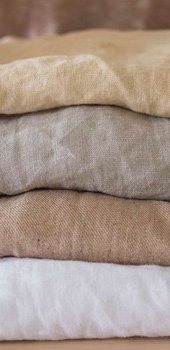
[IMAGE_PLACEHOLDER alt="Natural daylight flat lay of four undyed linen swatches side by side on a pale oak table: crisp white European flax, warm oatmeal organic linen, slightly slubbed recycled linen blend, and a soft grey recycled cotton blend, with a paper specification card and a tailor's tape measure"]The Four Routes in One Comparison
Start with the claim you want to publish, then work backwards to the certificate that supports it. Most sourcing mistakes happen in the opposite order: a fabric is chosen for handfeel, and a sustainability story is written around it afterwards.
The table below is the decision layer. It maps each route to the evidence a buyer receives, the pressure it puts on cost, and the product families where it performs best. Prices are not fixed percentages because certified fibre premiums move with crop, spinner capacity and order volume, but the relative direction is stable enough to plan a range.
| Route | What is actually certified | Evidence you receive | Cost pressure on FOB | Best fit |
|---|---|---|---|---|
| Organic linen (GOTS) | Organic fibre origin plus processing, chemical inputs, wastewater and social criteria across the textile chain | Scope certificate, transaction certificate per shipment, licence number, product category | Highest, driven by certified fibre scarcity and segregated production runs | Core hero styles, capsules with a published fibre story, markets that expect GOTS |
| Recycled linen or recycled cotton blend (GRS / RCS) | Recycled content percentage and, under GRS, chain of custody plus environmental and social requirements | Scope certificate, transaction certificate stating recycled content, blend composition | Moderate and often lower than organic, depending on the partner fibre | Denim-adjacent separates, casual shirts, jersey and knit-look linen blends, entry price points |
| Traceable European Flax® | Fibre origin in Western Europe and traceability through the supply chain; not an organic claim | Fibre supplier declaration, chain-of-custody records, spinner and weaver documentation | Low to moderate, close to conventional linen | Volume programmes where origin and low-input growing matter more than certification |
| Conventional linen, durability-led | Product safety and factory systems: OEKO-TEX Standard 100, ISO 9001, SEDEX | Test reports, factory certificates, audit reports | Lowest | Large repeat orders, workwear, hospitality, private label basics |
A single collection can use all four. The mistake is using one certificate to support a claim it was never designed to support.
Organic Linen: What GOTS Actually Certifies
GOTS is a processing standard with a fibre rule attached, not a farming certificate alone. It requires certified organic raw fibre, then controls what happens to that fibre at every processing stage: spinning, weaving, wet processing, dyeing, finishing and sewing. It sets limit values for chemical inputs, requires wastewater treatment, bans certain dyestuffs and auxiliaries, and adds social criteria across the certified facilities.
The label has two thresholds that buyers frequently confuse. Products may be labelled “organic” at 95% or more certified organic fibre, and “made with organic” at 70% or more. Anything below 70% cannot carry the GOTS mark at all. That single number decides whether your hangtag says organic or made with organic, so it belongs in the tech pack, not in a marketing deck.
The document that matters at shipment level is the transaction certificate. A scope certificate tells you a supplier is allowed to handle GOTS goods; a transaction certificate tells you this specific order, in this weight and product category, was certified. Auditors and marketplace compliance teams increasingly ask for both, and they check that the certified weight is plausible against the order quantity.
Cost pressure comes from three places. Certified organic flax is a smaller pool than conventional flax, so availability in specific yarn counts and widths is narrower. Segregated production runs mean the mill cannot blend certified and conventional lots freely, which raises minimums per quality. And certification administration, testing and audit costs are real, even if they are small per garment at volume.
In practice, organic works best as a focused capsule: two or three qualities, a restrained colour card, and hero styles that justify the price. If you are still mapping the difference between organic and simply natural, our guide to what organic linen is and how it is certified covers the fibre-level detail, while this article stays on the commercial comparison.
[IMAGE_PLACEHOLDER alt="Close-up of a GOTS scope certificate and a transaction certificate on a workbench beside folded natural linen fabric, a magnifying glass and a colour swatch fan, shot in soft window light"]Recycled Linen and Recycled Cotton Blends: Real Numbers, Not Slogans
Recycled linen is usually mechanical, not chemical. Offcuts from cutting rooms, yarn waste or post-consumer garments are shredded back to fibre and re-spun. The process uses far less water and energy than growing and processing virgin fibre, but it also shortens the staple length, and shorter staples mean lower tenacity, more pilling and a slightly more irregular surface.
That physics explains why almost no commercial recycled linen is 100% recycled. It is blended, typically with virgin linen, virgin cotton or a cellulosic partner, at ratios that trade story against strength. A 30% recycled linen, 70% virgin linen blend keeps a recognisable linen handfeel while carrying a meaningful recycled claim. Push the recycled share higher and the fabric softens, slubs more and loses tear strength, which matters most in trousers, workwear and anything with stress seams.
Certification here splits into two levels. GRS, the Global Recycled Standard, requires at least 20% recycled content for certification, verifies the full chain of custody, and adds environmental and social requirements at each certified facility. RCS, the Recycled Claim Standard, verifies recycled content from 5% and stops there: it is a content claim, not a sustainability programme. If your marketing leans on the word responsible rather than the word recycled, GRS is the stronger document.
Four questions decide whether a recycled quality is ready for production, and none of them can be answered by a supplier brochure:
- What percentage is recycled, and is the recycled content pre-consumer offcuts or post-consumer garment waste?
- What is the partner fibre, and was it chosen for strength, cost or handfeel?
- What are the measured tear and tensile figures against the virgin quality this replaces?
- How does the fabric behave after three washes, not one?
The last question matters most. Recycled blends often need a garment wash or compaction finish to stabilise shrinkage, which for untreated linen typically sits at 3-7% on the first wash. Without that finish, a 40% recycled quality can move enough to fail a fit repeat on the second production run.
| Blend direction | Handfeel result | Strength | Typical use |
|---|---|---|---|
| 20-30% recycled linen / 70-80% virgin linen | Very close to virgin, slight slub | Good | Shirts, dresses, overshirts |
| 40-50% recycled linen / 50-60% virgin linen | Softer, more irregular, vintage surface | Acceptable for light garments | Summer tops, loose trousers, loungewear |
| 30-50% recycled cotton / linen balance | Softer, less crisp, more drape | Moderate, improves with wash | Jersey-look knits, casual sets, entry price points |
| Recycled cotton rich with small linen share | Cotton-dominant, linen texture as accent | Moderate | Tees, sweatshirt-weight programmes, gift sets |
A recycled claim without a percentage and a certification scope is not a claim you can defend. Put the number in the specification, the certificate reference in the file, and the same number on the hangtag.
Traceable Linen: European Flax® and Chain of Custody
European Flax® is a trademark managed by the European flax and hemp confederation. It identifies fibre grown in Western Europe, primarily France, Belgium and the Netherlands, and it comes with a traceability framework that connects the fibre back to the growing region. It is a genuine differentiator, and it is routinely misread as an organic certification. It is not. European Flax® says where the fibre grew and how it was processed; it does not certify organic farming.
That distinction is useful rather than limiting. European flax is typically rain-fed, grown in rotation, and mechanically processed without the retting chemistry used in some other origins, which produces a defensible low-input story that does not depend on a certification that may be unavailable in your yarn count. For brands selling into markets where the word organic triggers scrutiny, origin traceability is often the safer narrative.
Chain of custody is where this route lives or dies. You need a fibre supplier declaration, documentation from the spinner and weaver, and a paper trail that matches weights from fibre lot to greige to finished fabric. Some suppliers now add third-party isotopic or DNA marker verification on top of documentation; those programmes are useful for high-visibility claims but they are not a substitute for consistent record keeping.
Traceability is also becoming a regulatory requirement rather than a marketing choice. The EU Digital Product Passport under the Ecodesign for Sustainable Products Regulation will push brands towards structured data on fibre origin, composition, durability and repairability. Suppliers who can already produce clean lot-level records will be cheaper to comply with than suppliers who cannot, and that gap is worth asking about during sourcing rather than after the first enforcement date. Our overview of the Digital Product Passport and linen traceability sets out what data to collect now.
GOTS vs OEKO-TEX: Two Different Questions
These two certificates are often listed together as if they were alternatives. They answer different questions, and most serious programmes need both.
GOTS asks: where did the fibre come from, and how was it processed? OEKO-TEX Standard 100 asks: is this finished article safe against a list of harmful substances? A GOTS-certified fabric is not automatically tested for every substance limit a retailer requires in trims, prints, interlinings or threads. An OEKO-TEX-certified fabric carries no information at all about fibre origin. One is a chain and process standard; the other is a product safety test.
| Certificate | Question answered | Scope | What the buyer receives |
|---|---|---|---|
| GOTS | Organic fibre and responsible processing | Fibre, processing, chemicals, wastewater, social criteria | Scope certificate plus transaction certificate per shipment |
| OEKO-TEX Standard 100 | Product safety | Finished article and all components, by product class | Test report and certificate number valid for one year |
| OEKO-TEX STeP | Facility-level environmental and social management | Factory systems, not a product | Facility certificate |
| GRS | Recycled content and chain of custody | Recycled input, processing, environmental and social criteria | Scope certificate plus transaction certificate with content percentage |
| RCS | Recycled content only | Content and chain of custody | Scope and transaction certificates |
The practical stack for a European or North American brand is usually GOTS or GRS on the fabric, OEKO-TEX Standard 100 on the finished garment including trims, ISO 9001 on the factory quality system, and a social audit such as SEDEX for the site. Linenwind holds ISO 9001, OEKO-TEX Standard 100 and SEDEX, and buys GOTS and GRS qualities against project requirements rather than keeping blanket certification on every stock line. That keeps stock fabric accessible while leaving certified routes open for programmes that need them. For a fuller map of factory-side certification, see our breakdown of linen manufacturer certifications.
Where the Premium Lands in Your FOB
Buyers often ask for a single percentage uplift for certified linen. There is no stable number, but there is a stable method. In a linen garment, fabric usually represents 30-45% of FOB and labour 25-35%. A fibre premium therefore enters through the fabric line and is multiplied by consumption, not by the whole garment.
Take a style using 2 metres of fabric. If the certified quality costs a few dollars more per metre than the conventional quality it replaces, the garment cost moves by roughly twice that per-metre difference, plus the mill's minimum-run penalty if the order is small. That is why the same certificate can feel cheap on a 3,000-piece programme and expensive on a 300-piece capsule: the fixed costs of segregation, testing and documentation are spread over fewer units.
| Cost driver | What moves it | How to control it |
|---|---|---|
| Certified fibre price | Crop year, origin, yarn count, availability | Book qualities early, accept two adjacent yarn counts |
| Segregated production | Mill minimum per certified quality | Consolidate colours, share one quality across styles |
| Testing and certification admin | Number of qualities, shipment count | Fewer qualities, fewer shipments, complete documentation |
| Yield and waste | Shrinkage, cutting efficiency, fabric width | Pre-shrunk or garment-washed finish, marker optimisation |
| Minimum order | MOQ 60 pieces per style and colour | Build colour stories around shared fabric, not shared style |
The cheapest certified collection is not the one with the lowest fibre price. It is the one with the fewest qualities, the fewest shipments and the cleanest documentation.
Quotation timelines are short enough to plan around: an initial response within 48 hours, a formal quotation in 3-7 working days once the tech pack is complete, sampling in 7-12 days, bulk in 25-35 days, and 35-60 days for a first order including fabric booking and shipping preparation. Sample fees run from $40 to $150 per style and are refunded against the bulk order; swatches are free. The commercial mechanics behind that structure are set out in our guide to low-MOQ linen manufacturing at 60 pieces.
[IMAGE_PLACEHOLDER alt="Sourcing manager and factory merchandiser reviewing a linen tech pack and cost sheet on a cutting table, with fabric rolls and a laptop showing a specification spreadsheet in the background"]Designing a Three-Tier Sustainable Collection
Most brands cannot put every style on the most expensive certified fibre and still hit margin. A tiered architecture solves this without diluting the story, because each tier makes a different, defensible claim.
Tier one is the volume base: traceable European Flax® qualities in your best-selling constructions, priced close to conventional linen and sold on origin, durability and low-input growing. This is where 50+ stock qualities matter, because you can develop quickly without a custom weave minimum.
Tier two is the certified capsule: GOTS organic linen in two or three qualities and a tight colour card, applied to hero silhouettes that can carry a higher retail price. Keep the certified range narrow enough that the transaction certificates are easy to manage and the mill run is efficient.
Tier three is the statement layer: GRS recycled blends in casual separates, overshirts or loungewear, where a slightly irregular surface reads as character rather than defect. This tier usually carries the most visible content story and the least price sensitivity.
The communication rule is one claim per tier. Do not put an organic claim on a recycled blend to strengthen it, and do not put a recycled claim on a conventional quality. Claim sprawl is the fastest way to fail a marketplace review, and it is entirely avoidable with a tier map agreed before sampling starts.
Claims You Can Publish, and the Wording That Fails Review
Regulators on both sides of the Atlantic have converged on the same principle: a general environmental claim must be substantiated, specific, and not broader than the evidence behind it. The US FTC Green Guides ask for competent and reliable evidence for each express and implied claim. European rules are moving in the same direction, with stricter treatment of unqualified umbrella terms and a growing expectation that claims be verifiable across the product life cycle.
For linen, three phrases cause most of the trouble. “Sustainable” used alone, with no qualifier. “Eco-friendly” applied to a whole garment because one component is certified. And “organic” applied to a blend below the threshold that permits it. The same discipline applies to the story around the product: a claim you cannot document with a certificate or a test report is a liability, not a differentiator, which is why we separate a verifiable sustainability story from campaign language.
| Avoid | Use instead | Why |
|---|---|---|
| 100% sustainable linen | GOTS-certified organic linen, 95% organic fibre | Specific, certificate-backed, threshold-accurate |
| Eco-friendly garment | Made with 30% GRS-certified recycled linen | Names the component and the verified share |
| Organic linen blend | Made with 70% organic linen, GOTS | Matches the labelling threshold for the mark used |
| Carbon neutral fabric | Rain-fed European flax, traceable to growing region | Removes an offset claim you cannot document |
| Biodegradable | Untreated 100% linen, plastic-free trims | Biodegradability depends on finishes and components |
Keep the evidence file per shipment, not per season. Certificates expire, scope certificates get amended, and transaction certificates are issued against specific weights. A claim that was defensible in March can become unsupported in September if nobody tracks validity dates.
The Specification That Survives an Audit
Certification problems are usually specification problems that surfaced late. A tech pack that states the fibre percentage, the certificate type, the licence holder and the shrinkage tolerance gives the mill, the testing lab and the marketing team the same facts.
- Fibre composition with the exact certified share, for example 100% organic linen or 30% recycled linen / 70% linen.
- Certificate type and licence or scope reference, with the product category the certificate covers.
- Fabric weight within the 100-260 gsm band, stated as a tolerance rather than a single number.
- Shrinkage allowance, typically 3-7% on the first wash for untreated linen, and the finish that controls it.
- Dye method and colourfastness requirement, especially for recycled blends where dye uptake varies.
- Trim and component list, because certification scope often stops at the shell fabric.
- Care label wording that matches the finish, not the fibre in the abstract.
- Inspection standard, AQL 2.5 on major defects unless the buyer specifies otherwise.
If a supplier cannot tell you which product category their certificate covers, treat the certificate as unverified until they can. Scope matters more than the logo on the PDF.
Sequencing a 2027 Sustainable Capsule
Lead times decide how much certification work is realistic. Working backwards from a spring delivery, the sequence below leaves room for one round of sampling revisions and one documentation correction, which is usually what actually happens.
| Stage | Duration | What must be ready |
|---|---|---|
| Brief and initial response | 48 hours | Style references, target weight, volume estimate, claim intent |
| Formal quotation | 3-7 working days | Tech pack, fabric selection, trim list, packaging |
| Sampling | 7-12 days | Approved fabric quality, confirmed colour standard |
| Sample review and revisions | 5-10 days | Fit comments consolidated in one round |
| Bulk production | 25-35 days | Approved sample, certificates verified, deposit received |
| First order end to end | 35-60 days | Fabric booking, trims, inspection, shipping preparation |
The certification work runs in parallel, not after. Request scope certificates at quotation stage, confirm the product category before sampling, and ask for the transaction certificate with the shipping documents rather than after the goods arrive. Brands that leave documentation to the end usually end up holding stock they cannot legally describe.
[IMAGE_PLACEHOLDER alt="Rows of finished linen shirts on a factory rail with certification folders and shipping cartons in the foreground, lit by daylight through high workshop windows"]Common Questions
Is recycled linen as strong as virgin linen?
Not at the same weight. Mechanical recycling shortens the fibre staple, so a high recycled share reduces tear and tensile strength. Most commercial qualities blend 20-50% recycled fibre with virgin linen or cotton to keep performance acceptable. For stress seams such as trousers and workwear, stay towards the lower recycled share or increase fabric weight.
Is European Flax® the same as organic linen?
No. European Flax® certifies origin and traceability of fibre grown in Western Europe. It does not certify organic farming. If your claim needs the word organic, you need a GOTS or equivalent organic certification, not an origin label.
What is the minimum order for a certified organic style?
Our garment MOQ is 60 pieces per style and colour, but certified fabric availability can set a higher effective minimum because mills run certified qualities in segregated lots. Consolidating colours onto one certified quality is the usual way to keep the order workable.
Do I need both GOTS and OEKO-TEX Standard 100?
Usually yes. GOTS covers fibre origin and processing; OEKO-TEX Standard 100 covers product safety of the finished article including trims and prints. Large retailers often require both, and they test different things.
How much more does certified linen cost?
There is no fixed percentage. The premium is a per-metre fibre difference multiplied by fabric consumption, plus segregation and documentation costs spread across the order. Small certified capsules carry a higher unit cost than large programmes in the same quality.
Can I get swatches before committing to an order?
Yes. Swatches are free. Sampling for a made-up style takes 7-12 days and carries a sample fee of $40-150 depending on complexity, refunded against the bulk order.
Next Step
Sustainable linen is a documentation discipline as much as a fibre choice. Decide which claim each tier will carry, match it to the certificate that supports it, and write the share and the scope into the tech pack before sampling. That sequence keeps the premium explainable and the hangtag defensible.
If you are comparing routes for a 2027 range, we can quote against your tech pack in 3-7 working days and send swatches from more than 50 stock qualities in the meantime. Start with the contact form and tell us which claim you need to support.