







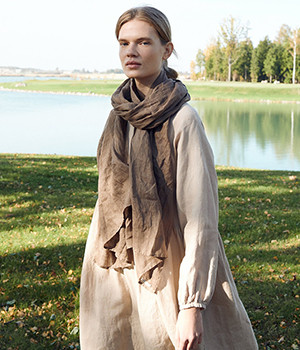

Petite and Tall Linen Ranges: Grading, Length and Market Demand
Petite and Tall Linen Ranges: Grading, Length and Market Demand
A petite or tall linen range is not a size range with longer or shorter hems bolted on. It is a second pattern block with its own grade rules, its own marker, its own fit tolerances and, in most factories, its own minimum order. Brands that treat it as a hem adjustment usually discover the real cost at the sample stage, when the armhole sits wrong, the waist lands in the wrong place and the wash pulls another two centimetres out of the length.
This guide sets out what actually changes when a linen programme is extended into petite and tall: how grade rules shift away from the missy block, which length deltas belong to which garment type, what fabric weight does to a longer or shorter silhouette, how the buying channels for these ranges differ, and where inventory risk hides once a style is split across three lengths and four colours. It also explains what a petite or tall surcharge pays for, so the number in a quote can be checked line by line rather than accepted as a mystery premium.
The pattern logic here builds on our size grading rules for natural-fibre garments, and assumes the factory-standard terms we quote everywhere: MOQ 60 pieces per style per colour, sampling 7-12 days, bulk 25-35 days, first order 35-60 days, and first-wash shrinkage of 3-7% on loom-state linen.
Petite and Tall Are Length Problems With a Proportion Problem Inside
Petite and tall ranges exist because the human body does not scale uniformly. A woman of 5'2" is not a 5'7" woman reduced by 7%. Her torso is shorter in a different ratio than her legs, her bust point sits higher relative to her shoulder, her rise is shorter, and her arm length is not simply proportional. A tall woman of 5'11" has the mirror problem: the same nominal size may fit her chest and still leave the waistband three centimetres too high and the sleeve short by four.
That is why a length-only adjustment fails. If you take a missy block and add 6 cm to the body hem, you move the hem but not the waist, not the bust point, not the armhole depth and not the knee break. The garment looks longer in a photograph and feels wrong on a body. Buyers return it, and the return reason is usually written as "fit" rather than "length", which makes the pattern fault harder to trace.
The practical definition we use with brands is simple. A petite range is a block graded for a shorter vertical proportion, with a defined height band at its centre. A tall range is the same idea in the other direction. Both keep the horizontal measurements close to the missy size they are derived from, so a customer who wears a medium in your core line can order a medium petite and expect the chest and hip to fit while the length and vertical placements change.
- Petite centre height: commonly 5'0" to 5'4", with the block drafted around 5'2".
- Tall centre height: commonly 5'8" to 6'0", with the block drafted around 5'10" for women and 6'2" for men.
- What stays: chest, waist and hip circumferences at the same nominal size.
- What moves: body length, sleeve length, rise, waist position, bust point, armhole depth and, in some blocks, shoulder slope.
How the Grade Rules Shift Away From the Missy Block
Grade rules are the arithmetic that turns one base size into a run. In a missy block, body length usually grows 1.5-2 cm per size step and sleeve length about 0.5-0.75 cm. Petite and tall blocks keep the horizontal grade almost unchanged and change the vertical grade, because the population they serve is not taller or shorter in the chest.
The cleanest way to build the range is a two-step process. First, draft the petite or tall base block at the centre height by applying a fixed set of vertical deltas to the missy base. Second, grade that new base across the size run using the same horizontal increments as the core line and a reduced or expanded vertical increment. This keeps size-to-size consistency and avoids the common error of applying a single "petite offset" to every size in the run, which produces a range that fits at the centre and drifts at the edges.
| Grade element | Missy block | Petite block | Tall block |
|---|---|---|---|
| Body length per size | 1.5-2.0 cm | 1.0-1.5 cm | 2.0-2.5 cm |
| Sleeve length per size | 0.5-0.75 cm | 0.4-0.6 cm | 0.75-1.0 cm |
| Rise per size | 0.5-0.75 cm | 0.4-0.5 cm | 0.75-1.0 cm |
| Waist-to-hem placement | Base | -3 to -5 cm | +4 to +7 cm |
| Bust point drop per size | 0.4-0.5 cm | 0.3-0.4 cm | 0.5-0.6 cm |
| Armhole depth per size | 0.5 cm | 0.4 cm | 0.5-0.6 cm |
Two details matter more than the table. First, the grade must be linear in the vertical direction or the range will fit at the ends and not in the middle. Second, the petite and tall blocks should be graded as separate pattern sets with their own size break, not as an offset applied at cutting. A cutting-room offset cannot correct a bust point or an armhole, and it is invisible in the tech pack, which means the next order repeats the fault.
Length Deltas by Garment Type
There is no single petite or tall delta. The number depends on where the garment breaks on the body and how much of the silhouette depends on that break. A shirt hem that sits at the hip can move 5 cm without changing the look. A wide-leg trouser that breaks at the instep cannot move 5 cm without changing the entire proportion, and a maxi dress that clears the ankle by 2 cm has almost no room to move at all before it becomes a floor-length garment.
| Garment | Petite delta | Tall delta | What else must change |
|---|---|---|---|
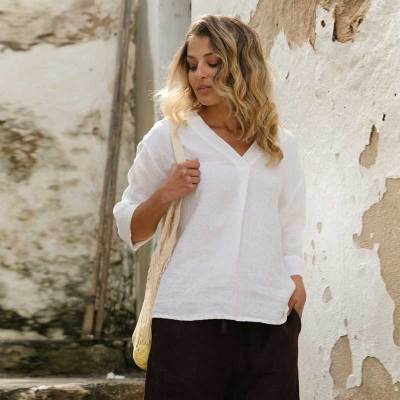
| Linen shirt / blouse | -4 to -6 cm body, -2 cm sleeve | +5 to +7 cm body, +2 to +3 cm sleeve | Bust point, waist placement, pocket position |
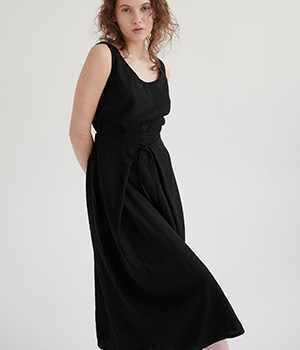
| Linen dress, knee length | -5 to -7 cm | +6 to +9 cm | Waist seam, bust point, hip notch, dart length |
| Linen dress, maxi | -7 to -10 cm | +8 to +12 cm | Hem sweep, side slit height, lining length |
| Wide-leg trouser | -4 to -6 cm inseam | +5 to +8 cm inseam | Rise, knee break, pocket depth, cuff |
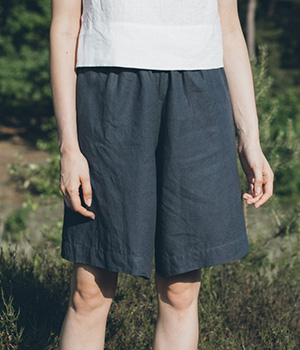
| Linen shorts | -2 to -3 cm | +3 to +4 cm | Rise, hem sweep, pocket bag |
| Linen jacket / overshirt | -3 to -5 cm body, -2 cm sleeve | +4 to +6 cm body, +2 to +3 cm sleeve | Waist suppression, pocket flap, vent length |
These are working ranges, not laws. The point is that each delta has a partner change. If the body length moves but the waist seam does not, the garment reads as a dress worn low. If the sleeve moves but the cuff opening does not, the cuff sits on the hand. If the dress length moves but the side slit does not, the slit moves down the leg and the walk cycle changes.
For linen specifically, add the wash allowance before you fix the delta. A garment that finishes at 110 cm in the grey state may lose 3-7% in the first wash, which is 3.3-7.7 cm. On a petite maxi that is the difference between clearing the ankle and sweeping the floor. Decide the finished, post-wash length first, then work backwards through the shrinkage allowance to the cutting length. Our guide to controlling linen shrinkage before cutting covers the test method in detail.
Pattern Changes That Are Not Length
Most of the work in a petite or tall block is not length at all. It is the set of vertical placements that decide where the garment sits on the body. Skipping them is the most common reason a range samples well on a fit model and fails in the market.
- Bust point. Raise it 1.5-3 cm on petite, lower it 1.5-3 cm on tall. A misplaced bust point pulls the side seam forward and makes the front hem lift.
- Waist placement. Move the waist seam or the waist shaping up 2-4 cm on petite and down 3-5 cm on tall. On a linen dress with a defined waist, this is the single most visible change.
- Armhole depth. Reduce 0.5-1.5 cm on petite and increase 0.5-1.5 cm on tall. A deep armhole on a short torso exposes the bra band and restricts movement.
- Shoulder slope and width. Petite blocks often need a slightly steeper slope and a shoulder point pulled in 0.5-1 cm. Tall blocks often need a flatter slope.
- Rise. Shorten 2-4 cm on petite, lengthen 2-5 cm on tall, and check the crotch curve rather than only the front rise.
- Pocket and trim placement. Chest pockets, patch pockets and belt loops are positioned off the waist and shoulder, so they move with those points.
Each of these is a pattern change, and each one has to be recorded in the tech pack. A tech pack that specifies only body length will produce a garment that is longer or shorter and still wrong. Our tech pack guide for linen clothing lists the fields that need to be present before a factory can build a second block without guessing.
Who Actually Buys Petite and Tall Linen
Demand for these ranges is concentrated in channels that can present them as a distinct fit promise rather than a size extension. That channel structure explains why the same product can sell well in one market and sit in another.
- Specialist retailers. Stores whose entire proposition is petite or tall sizing can carry a full length line, because the customer already shops by fit rather than by trend.
- Direct-to-consumer brands. Online brands use length as a filter and a landing page. A petite or tall edit gives them a reason to buy traffic against a specific search phrase and a reason for a customer to return.
- Department-store fit departments. Larger retailers often run petite as a department and tall as a catalogue or online extension, which changes the depth of the range each one needs.
- Uniform and hospitality programmes. Height spread inside a single workforce is wide, and a uniform programme that offers two lengths reduces alteration cost at the site.
- Wholesale accounts in Northern Europe and North America. Markets with a taller average population tend to support tall ranges as a core option rather than a niche add-on.
What these channels share is a customer who has already been disappointed by standard sizing. That is an advantage and a trap. The advantage is loyalty: a petite customer who finds a linen dress that finally breaks at the right point on the leg tends to buy again. The trap is intolerance for approximation. This customer has returned garments before and will measure the one you send.
Fabric Weight and Drape at Different Lengths
Linen does not behave the same way at 95 cm and at 135 cm. A lightweight 120-140 GSM linen that falls well at a hip-length shirt can collapse into a narrow column on a maxi dress, while a 200-240 GSM linen that holds a structured jacket can feel like a board in a wide-leg trouser. Length amplifies weight.
The rule we apply is to match the fabric weight to the longest drop in the style, not to the average. For a tall maxi, a 150-180 GSM linen with a soft finish gives movement without clinging; for a petite knee-length dress, 160-200 GSM holds the line and stops the hem from collapsing into the knee. For trousers, 180-220 GSM keeps a wide leg hanging cleanly, and above 240 GSM the drape stiffens enough that the silhouette reads as workwear rather than resort.
Two practical checks before bulk. First, cut the longest length in the range from the actual fabric lot and hang it for 24 hours; linen continues to drop on the bias. Second, wash the sample and re-measure at three points: centre front length, side seam length and hem sweep. If the long length moves more than the short length, the marker allowance is wrong and the tall sizes will finish short.
Minimums, Colour Runs and Inventory Risk
This is where petite and tall ranges usually fail commercially rather than technically. A single style in three colours and four sizes is one production block. The same style split into core, petite and tall is three blocks, each with its own pattern, marker, sample and quality record. At MOQ 60 pieces per style per colour, a modest line multiplies quickly.
| Range structure | Style-colour blocks | Minimum units at 60 pcs | Main risk |
|---|---|---|---|
| Core only, 3 colours | 3 | 180 | Low |
| Core + tall, 3 colours | 6 | 360 | Colour balance across two blocks |
| Core + petite + tall, 3 colours | 9 | 540 | Slow sellers stranded in one length |
| Core + petite + tall, 4 colours, 2 fabrics | 24 | 1,440 | Working capital and end-of-season residual |
The inventory risk is not evenly distributed. Petite and tall are usually the thinner blocks, which means the size curve inside each block is flatter and the middle sizes dominate. If you buy the same size ratio as the core line, you will overbuy the extremes and underbuy the centre. Build the buy on the block's own sales history, or on a deliberately narrow launch curve, and keep the first order shallow in the outer sizes.
There is a second, quieter risk: colour continuity. A petite and tall block produced as a separate dye lot can arrive a shade off the core line. On a natural-fibre garment in ecru, sand or stone, a half-shade difference is visible on a shelf and in a flat-lay. Where possible, run all lengths from one fabric lot and one dye batch, even if cutting is separate. When that is not possible, ask for lab dips across the whole range and approve them together.
For brands already running a plus-size block, the same logic applies with an added constraint: the larger the size spread, the more the marker efficiency and fabric consumption change. Our breakdown of plus-size pattern adjustments and fabric consumption shows how the cost curve behaves once a block moves away from the base size.
What the Petite or Tall Surcharge Actually Pays For
A surcharge on a petite or tall range is not a penalty for being different. It is the amortisation of work that the core line does not need, spread over a smaller number of units. Four cost lines account for most of it.
- Pattern and grading. A separate base block, a separate grade table and a separate fit sample. This is a one-off cost per style, so its per-unit effect falls as volume rises.
- Marker efficiency. A shorter or longer block nests differently on the fabric. Small blocks can lose 2-5% more fabric at the marker, and on linen, where the fabric is often 30-45% of unit cost, that loss is visible.
- Smaller production runs. Setup, cutting, bundling and line changeover are spread over 60 pieces instead of 300. Labour is 25-35% of unit cost, and the fixed share of it does not shrink with the order.
- Labels, packing and QC. Separate size labels, separate polybags, separate carton marks and a separate AQL 2.5 inspection record for the block.
The honest way to quote it is to separate one-off development cost from per-unit cost. Development, including the extra block and sample round, is a fixed number that can be amortised or charged once. The per-unit premium should then reflect marker loss and run size only. If a quote presents a single percentage with no breakdown, ask which of the four lines it covers, and whether the pattern cost is being charged twice across seasons.
QC and the Spec Sheet Fields That Prevent Rework
Petite and tall blocks fail in inspection for predictable reasons. The spec sheet should carry the numbers that make those failures detectable before the carton is sealed.
- Finished body length after wash, per size, with a tolerance band of plus or minus 1 cm.
- Sleeve length from shoulder point and from centre back, both measured.
- Waist position from high point shoulder, not from the hem.
- Rise, inseam and knee break for trousers, measured on the garment, not the pattern.
- Bust point from high point shoulder, and dart length.
- Armhole depth measured straight and over the curve.
- Hem sweep at the finished length, because sweep changes when length changes.
- Shrinkage result from the actual lot, recorded as a percentage per direction.
Inspection itself follows the same AQL 2.5 plan as the core line, but the measurement sample must be drawn per block rather than pooled. Pooling three blocks into one measurement report hides exactly the drift you are trying to catch. Our guide to linen garment inspection sets out the sampling logic and the checkpoints that matter on natural-fibre garments.
A 90-Day Launch Sequence
A petite or tall line can be launched inside a normal season calendar if the block work starts early. The sequence below assumes the core style already exists and only the length block is new.
- Weeks 1-2: confirm the height band, the size range and the finished post-wash lengths. Approve the fabric lot for all lengths.
- Weeks 3-4: draft the petite or tall block, grade it, and cut the first fit sample. Sampling runs 7-12 days from an approved tech pack.
- Weeks 5-6: fit on at least two wearers inside the height band, correct vertical placements, and re-cut if the armhole or bust point moved.
- Weeks 7-8: approve the second sample after one wash, lock the spec sheet and the grade table, and confirm the buy by size and colour.
- Weeks 9-13: bulk production at 25-35 days, with the measurement sample drawn per block and the AQL 2.5 inspection booked before packing.
- Week 14: first order delivery, which typically lands at 35-60 days from order confirmation once sampling is approved.
If the range is being developed from scratch rather than extended, add two weeks to the front of the plan for fabric selection and lab dips. The rest of the sequence holds.
Questions Buyers Ask Before Starting a Length Line
Building the Range Without Doubling the Risk
The brands that make petite and tall work treat them as a fit promise with a defined height band, a separate block and a shallow first buy. They launch one or two hero styles per length rather than a full collection, prove the size curve, and extend only after the return rate and the sell-through confirm the block. That sequence costs less than a broad launch and produces a better-fitting second season.
If you are planning a petite or tall extension for spring or resort, start with the fabric and the finished length, then let the block follow. We can quote a second block, a sample round and a bulk price from a tech pack and a size range, with an initial reply inside 48 hours and a full quote in 3-7 working days. Send your spec through our contact page, or read the FAQ for minimums, sampling and payment terms before you brief the range.