Custom Linen Clothing Production Process Explained Step by Step
Updated August 2026
Custom Linen Clothing Manufacturing
Custom linen clothing starts long before a bolt of fabric reaches a sewing machine. Between the moment a brand shares its design and the day finished garments leave the factory, the work passes through nine distinct production stages: fabric sourcing and inspection, pre-treatment and shrinkage control, pattern making and grading, sampling and approval, cutting, sewing, washing and finishing, quality inspection, and labeling and shipment. Each stage exists for a reason, and each one is where a less experienced factory can quietly introduce the defects that turn into returns, fit complaints, and chargebacks.
Linen is one of the most demanding natural fibers to manufacture. It shrinks, it relaxes, it dyes unevenly across batches, and it puckers at the seams when thread tension is not calibrated for a low-twist natural yarn. A generic garment factory that handles cotton tees and polyester activewear may not have the equipment, the trained operators, or the testing protocols that linen requires. That is why a structured, step-by-step production process is not an administrative detail — it is the difference between a consistent product and a costly experiment.
This guide explains each stage of the custom linen clothing production process as it is actually run at Linenwind, a specialized linen garment factory in China with over two decades of dedicated linen manufacturing experience. Throughout, we use the real parameters we quote to buyers every day: a standard MOQ of 60 pieces per style, sample development in 7–14 days, bulk production in 25–35 days, and pre-shrinkage testing on every fabric lot before cutting begins.
If you are evaluating a custom linen clothing manufacturer for the first time, this guide also gives you the vocabulary to ask the right questions: what shrinkage testing they run, whether they produce a pre-production sample before bulk, which AQL standard they inspect against, and how they document specs for reorders. The answers to those questions reveal more about a factory's capability than any catalog page.
20+
Years Linen Manufacturing
Why the Production Process Matters for Custom Linen Clothing
Every natural fiber has its own manufacturing behavior, and linen's behavior is more demanding than most. Linen yarn is spun from flax fibers that have relatively low elasticity, which means the fabric does not stretch or recover the way cotton knits do. It also has a higher shrinkage rate — typically 3–7% on the first wash depending on the weave, weight, and finishing treatment. If a factory cuts garments without accounting for that shrinkage, the finished pieces can come out of the first consumer wash a full size smaller than the label states.
Linen also absorbs dye differently than synthetic blends, so shade consistency across production batches requires controlled dyeing and careful inspection under consistent lighting. The fabric's crisp texture makes surface defects more visible than they would be on a printed synthetic. And lightweight linen is prone to seam puckering when sewing tension, needle size, and stitch density are not adjusted for the fiber. These are not theoretical risks; they are the most common quality complaints we see from brands that previously sourced linen from general apparel factories.
Why process discipline pays off: a structured production process with documented specs, inline checks, and archived records means your first order and your tenth reorder come from the same approved construction. For custom linen clothing, consistency across batches is what protects your brand's fit reputation and minimizes returns.
Who this process serves: fashion brands commissioning private-label linen, boutique labels launching a capsule collection, DTC companies scaling a linen category, and designers who need OEM execution of their own tech packs. Most of Linenwind's custom linen clients are based in the US, EU, Australia, and the UK, and every order — whether 60 pieces or 600 — runs through the same nine stages below.
Step 1: Fabric Sourcing and Inspection
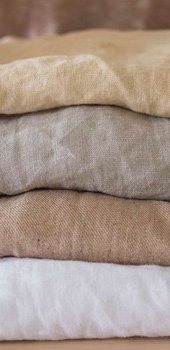
Custom linen clothing begins with choosing the right fabric, because the fabric determines the garment's hand feel, drape, appearance, care behavior, and roughly 50–60% of the final unit cost. We select 100% linen or linen blends (linen-cotton, linen-viscose, linen-Tencel, linen-hemp), often from European flax or equivalent long-staple sources, and verify the GSM, weave density, color consistency, and surface condition of every incoming lot.
Fabric inspection is not a formality. Linen's natural slubs and texture variations make defects more visible than in synthetic fabrics, so every roll is checked against the approved shade standard before it is accepted into production. If a lot does not match, it is rejected or re-matched before any cutting happens.
| Fabric |
GSM Range |
Hand Feel |
Best For |
| 100% Linen |
130–200 gsm |
Crisp, breathable, natural texture |
Classic shirts, relaxed tailoring |
| Linen-Cotton |
150–200 gsm |
Stable, easy care, approachable |
Mass-market lifestyle pieces |
| Linen-Viscose |
140–180 gsm |
Soft, fluid drape, fewer wrinkles |
Dresses, resortwear, blouses |
| Linen-Tencel |
130–170 gsm |
Silky, refined, eco-luxury |
Designer and premium collections |
| Linen-Hemp |
140–190 gsm |
Rustic, durable, sustainable |
Eco-focused niche brands |
For custom programs, we typically recommend two or three fabric options with different GSM levels and blends so you can compare hand feel, drape, and cost before committing. If you already have a specific fabric in mind, we can source it, or we can work under a CMT (cut-make-trim) arrangement with customer-supplied fabric.
Fabric choice also drives price. European flax linen sits at the higher end of the range, while equivalent long-staple Asian linen offers a more accessible cost profile; specialty blends such as linen-Tencel or linen-hemp sit above standard 100% linen. Because fabric typically accounts for 50–60% of the unit cost of a woven linen garment, locking the fabric decision early gives you an accurate costing picture before pattern work begins.
Step 2: Pre-Treatment and Shrinkage Control
Before a single panel is cut, every fabric lot goes through pre-treatment and dimensional stability testing. This stage is the heart of linen manufacturing and the reason our finished garments hold their labeled size after washing. The fabric is pre-washed or the garment-wash plan is defined, and we measure shrinkage, twist, and dimensional stability to determine the exact pattern allowance required.
- Pre-wash testing — a sample of each lot is washed and measured so the shrinkage rate is known, not assumed.
- Pattern allowance — based on the tested result (typically 3–7% for linen), we add a calculated allowance to pattern dimensions, usually 5–8% depending on the fabric.
- Colorfastness checks — dye and finish behavior is verified before bulk cutting so the approved look survives the first consumer wash.
Linen-specific reality: linen's shrinkage is influenced by weave, weight, and finishing. A factory that skips this step and cuts straight from the greige fabric is gambling with your size specs. We share the shrinkage test report as part of pre-production documentation on request.
There are two common approaches here: pre-washing the fabric before cutting, or planning a garment wash after sewing. Each has different effects on hand feel, color, and measurement stability, and the right choice depends on your design and care label. What matters is that the decision is made deliberately and verified by testing — not left to chance on the production floor.
Step 3: Pattern Making and Grading
Your tech pack — or your sketches and measurements — becomes a set of CAD patterns engineered for linen's behavior. Pattern making for linen requires different tolerances than for cotton or synthetics: seam allowances typically run 1–1.5 cm, critical measurements carry tolerances around ±0.5 cm, and the pattern must build in the shrinkage allowance established in Step 2.
Grading then scales the base pattern across your size range (commonly XS–XL or S–2XL, or custom ranges for kids' and men's lines). Consistent grading matters because a size run that drifts between sizes creates fit complaints that are expensive to resolve after shipment. At Linenwind, pattern development and grading are done in-house by pattern makers who work exclusively on linen and linen-blend garments.
Step 4: Sampling and Approval
Sampling is a required step before any first-time bulk production. We produce a prototype sample for fit and construction validation, then a pre-production sample (PPS) cut from the final fabric with the final trims, labels, and finishing. Nothing goes into bulk until the PPS is approved.
- First-fit sample — produced within 7–14 days of confirmation, with up to two fit revision rounds included in the standard sampling fee.
- Wash and finishing confirmation — the sample is washed the way the final garment will be washed, confirming shrinkage, hand feel, and appearance.
- Sample fee credit — the sample cost (typically USD 40–150 per piece depending on style complexity) is credited back on your first bulk order of the same style.
For buyers, the sample is also the moment to verify everything on paper: seam construction, button and trim placement, label coordinates, and the fit on your target body shapes. Approving a thorough sample is the cheapest quality control you will ever buy. If the sample reveals a pattern or construction issue, correcting it at this stage costs days — correcting it after bulk production costs weeks and real money.
For international buyers, in-person fitting is replaced by a documented fit review: high-resolution photos, a detailed measurement report, and, when needed, a video fit evaluation. We document any recommended adjustments to pattern or construction so the approved version is unambiguous before cutting begins.
Step 5: Fabric Cutting
Once the PPS is approved, the fabric is allowed to relax before cutting, then laid and cut in controlled layers. Linen can distort if it is cut too soon after unwinding or under uneven tension, so layer-controlled cutting with stable markers protects the grain of every panel. Each cut lot is tracked so that pieces from the same batch stay together through sewing, which keeps shade and texture consistent within an order.
Cutting efficiency also affects cost: marker layout is optimized to minimize fabric waste without compromising grain direction. For striped or checked linen, pattern placement is checked so the matching points land correctly at seams — a detail that separates a premium finish from an obvious compromise.
Step 6: Sewing and Assembly
Sewing is where linen's personality demands the most from operators. Linen requires a slower, more precise sewing pace than cotton or synthetics: correct needle selection, thread tension calibrated for low-twist natural yarn, and stitch density in the 8–12 stitches-per-inch range that suits the fabric weight. Seam reinforcement, bar tacks at stress points, and appropriate seam finishing prevent the puckering and seam slippage that lightweight linen is prone to.
Inline inspections run throughout sewing — seam quality, stitch consistency, and construction accuracy are checked as the garments progress through the line, not only at the end. Our sewing operators are trained specifically on linen techniques, which is one of the reasons a dedicated linen factory produces noticeably cleaner seams than a general apparel workshop on the same design.
Operator training is a genuine differentiator. A sewer who has spent years on linen knows how the fabric moves under the presser foot, when to slow down at a curved seam, and how to handle the slubs and weave irregularities that are natural to flax. That experience cannot be replaced by a machine setting, and it is why we keep dedicated linen production lines rather than mixing linen orders into general apparel runs.
Step 7: Washing, Dyeing and Finishing
This stage defines the final look, hand feel, and dimensional stability of the garment. Depending on the design, we apply garment wash, enzyme wash, or softening processes, then check colorfastness and appearance. Final pressing and shaping give the garment its retail-ready form.
Because washing can change a garment's measurements, the finished pieces are checked against the approved spec after washing rather than only before it. This post-wash verification is the practical guarantee that the size on the label is the size the consumer receives after the first wash — the exact point where linen sourcing projects usually fail.
The finishing program is chosen per style. A crisp, structured shirt may receive a light garment wash for softness, while a resort dress may get an enzyme wash for an aged, relaxed hand feel. The wash type, temperature, and finishing chemistry are locked at the sampling stage, so the bulk order reproduces the approved sample rather than drifting batch to batch.
Step 8: Quality Control and Inspection
Quality control runs through the whole process — inline checks at each stage — and concludes with a final inspection before packing. We inspect measurements, defects, and appearance against the approved sample, using AQL 2.5 sampling or brand-specific standards when you require them.
Measurement Verification
Critical points such as shoulder width, armhole depth, chest, and length are checked against spec with the ±0.5 cm tolerance agreed in the tech pack.
Shade and Appearance
Garments are inspected under consistent lighting for shade consistency within the batch and against the approved sample standard.
Documented Records
Archived specs, sample photos, and inspection results ensure that reorders match previously approved batches instead of drifting.
Step 9: Labeling, Packing and Shipment
The final stage covers private-label application, folding, packaging, and export preparation. We apply your woven labels, hang tags, and branded packaging, then fold and pack the garments — usually in poly bags with carton packing — and prepare the export documentation. Shipment options include FOB from Shanghai or Ningbo ports, CIF, and door-to-door express via DHL, FedEx, or UPS for smaller orders. Ocean freight is standard for bulk orders; air freight is available for time-sensitive restocks.
For custom linen clothing programs, this stage is also where your brand's retail readiness is decided: correct label content for your target market (for example FTC rules for the US, UKCA for the UK, and EU Textile Regulation for Europe), clean folding, and carton marking that matches your logistics requirements.
Production Timeline and MOQ Benchmarks
Below are the realistic stage durations we quote for custom linen clothing programs. These are working ranges, not worst-case estimates, and they assume a complete tech pack or clear reference materials at the start.
| Stage |
Typical Duration |
Notes |
| Fabric sourcing and inspection |
3–7 days |
Faster with our standard fabric library |
| Pre-treatment and shrinkage testing |
3–5 days |
Standard for every linen lot |
| Pattern making and grading |
3–5 days |
After tech pack confirmation |
| Sampling and approval |
7–14 days |
Up to two fit revision rounds included |
| Cutting |
2–3 days |
After PPS approval |
| Sewing and assembly |
10–15 days |
Inline QC throughout |
| Washing and finishing |
3–5 days |
Includes post-wash measurement check |
| Quality control |
2–3 days |
AQL 2.5 final inspection |
| Labeling, packing, shipment |
1–2 days |
Ocean or express per order |
First order vs reorder: a complete first order typically takes 50–65 days from inquiry to shipment. Repeat orders of an approved style typically take 35–45 days because fabric, pattern, and sample are already locked. Standard MOQ is 60 pieces per style across sizes; OBM private-label styles can start as low as 30–50 pieces per SKU.
Common Pitfalls in Custom Linen Clothing Production
Most sourcing problems are predictable, and they are almost always the same ones. Knowing them in advance protects your timeline and your budget:
- Skipping the pre-production sample — going straight to bulk without an approved PPS increases the risk of spec errors, sizing mismatches, and quality disputes that are expensive to fix after shipment.
- No shrinkage testing — cutting linen without testing the actual lot means the finished garments may not hold their labeled size after the first wash.
- Incomplete tech packs — missing measurements or unclear construction details produce inaccurate first samples and extra revision rounds.
- Unrealistic timelines — expecting 7-day sampling or 15-day bulk on a first order ignores the very stages that protect quality; plan for the 50–65 day first-order cycle.
What to Prepare Before Starting a Custom Linen Clothing Project
A smooth production process starts with a complete brief. Here is what speeds up every stage:
- Tech pack or equivalent — measurement charts, construction details, fabric specifications, and trim details. If you do not have a tech pack, sketches with measurements or reference photos with modification notes are enough to start.
- Fabric direction — target GSM, blend preference, and color direction, or ask us to recommend options from our fabric library.
- Market and compliance needs — target markets (US, EU, UK, Australia) so labels and certifications are planned correctly, including any organic linen requirement (GOTS is available on request).
- Timeline and shipping preference — seasonal deadlines, and whether you need ocean freight or express delivery.
Frequently Asked Questions
What is the minimum order quantity for custom linen clothing?
The standard MOQ is 60 pieces per style across all sizes — low enough for capsule testing and high enough to keep production efficient. Repeat orders can scale to 500+ pieces per style with a reduced per-unit cost.
How long does sampling take and what does it cost?
A first-fit sample is produced within 7–14 days of confirmation, with up to two fit revision rounds included. Sample costs range from USD 40–150 per piece depending on style complexity and are credited back on your first bulk order of the same style.
Can I provide my own fabric for production?
Yes, we accept customer-supplied fabric under a CMT (cut-make-trim) arrangement. For first orders we recommend using our sourced fabric because every lot is pre-tested for shrinkage and consistency before cutting.
How is linen shrinkage handled in production?
Every fabric lot is pre-washed and tested for shrinkage, twist, and dimensional stability before cutting. Based on the tested result (typically 3–7%), we add a calculated allowance of about 5–8% to pattern dimensions, and finished garments are re-verified after washing.
What certifications does Linenwind hold?
We align with OEKO-TEX standards for fabric safety, operate under BSCI social compliance principles, and run standardized quality management systems. GOTS certification is available for organic linen orders upon request.
How do I start a custom linen clothing project?
Send an inquiry through our
contact page with your brand background, target market, and product concept. We respond within 1–2 business days with fabric recommendations, estimated costing, and a proposed timeline.
Final Thoughts
Custom linen clothing production is a nine-stage process, and the quality of the final garment is only as strong as the weakest stage. Fabric that was never tested for shrinkage produces size drift. A sample that was never washed produces post-laundry surprises. Sewing without linen-calibrated tension produces puckered seams. A structured process — with pre-treatment testing, approved pre-production samples, inline QC, and documented records — is what turns a linen idea into a consistent, reorderable product.
At Linenwind, every custom program runs through this same framework, whether it is a 60-piece test or a 600-piece reorder. You can see the process applied across our product range, from custom linen tops and custom linen dresses to shirts, sets, and loungewear, and learn more about how we work on our company profile.
The bottom line for buyers is simple: the factory's process is your product. A manufacturer that tests every fabric lot, produces and approves a pre-production sample, runs inline inspection, and archives specifications is the one that will deliver a consistent custom linen clothing line — and reorder it identically next season.
60 pieces per style. 7–14 day sampling. 25–35 day bulk production. 20+ years of linen expertise.
Ready to plan your custom linen clothing production? Contact Linenwind to start the conversation, or send your project details directly through our inquiry form.